Here is the number that should change how you plan. Orgvue, in research published 12 March 2026 covering 300 US HR managers, found 32% of organizations that made redundancies on the cost-saving promise of AI have had to rehire staff. Not restructured. Rehired. A year earlier, a separate wave found 55% of leaders who made AI-driven redundancies said they got those decisions wrong.
Those organizations did not fail because they lacked a forecast. They failed because they believed one. Somewhere in the deck was a headline figure about AI and jobs, quoted confidently, doing enough work to justify a permanent decision about people.
Workforce scenario planning is what you do when the honest answer to “how much will AI change our headcount” is that nobody knows. It is harder than a point estimate, not softer, because it forces you to name what you would do differently under each future instead of hiding uncertainty inside one number.
You’ll get two things here: how to read the AI labor numbers correctly, and the craft of building scenarios that survive being wrong.
The most-quoted AI jobs number says the opposite of what people think
Start with the World Economic Forum’s Future of Jobs Report 2025, published January 2025 and built on a survey of more than 1,000 employers representing over 14 million workers across 55 economies. Its projection is 170 million new jobs created and 92 million displaced by 2030, a net gain of 78 million, alongside structural churn equal to 22% of today’s jobs, per the WEF Future of Jobs 2025 digest.
Now the figure that circulates. The report says 40% of employers “anticipate reducing their workforce where AI can automate tasks.” WEF’s press release renders it as 41%, which is why you see both numbers. That claim is scoped. Employers expect headcount to fall in the specific areas where AI automates tasks. It is a task-level statement about pockets of work, not an enterprise headcount forecast, and not a prediction that 40% of companies will shrink. Quoted alone it inverts the report, which also found 85% of employers planning to prioritize upskilling and 70% planning to hire for new skills.
The second framing problem matters more. These are employer expectations elicited in a survey. WEF is not modeling the labor market, it is aggregating what a thousand employers said they expect. That tells you what your peers will probably do, not what AI can do to a job.
Technical potential is not a headcount plan
The second most-quoted number comes from the McKinsey Global Institute. In Agents, robots, and us, published 25 November 2025, MGI estimates that currently demonstrated technologies could in theory automate activities accounting for about 57% of US work hours today, split between AI agents at 44% of hours and robots at 13%. The analysis is in McKinsey’s work on skill partnerships in the age of AI.
The qualifiers carry the meaning. This is technical automation potential: what demonstrated technology could do if companies redesigned workflows around it. It is not adoption, not headcount, not a forecast. Coverage rendering it as “AI could replace 57% of US work hours” makes a materially different claim, and it should never be a planning assumption.
The more useful finding is one almost nobody quotes. MGI found more than 70% of the skills employers seek today are used in both automatable and non-automatable work. Skills do not sort into safe and doomed. The same capability appears on both sides of the line, so title-based exposure analysis will mislead you, and the skills you are tempted to stop funding are probably load-bearing elsewhere.
What has actually happened, according to payroll data
The sharpest signal comes from the Stanford Digital Economy Lab. Canaries in the Coal Mine?, published November 2025 and updated 12 August 2026, uses ADP administrative payroll data covering millions of US workers through June 2026. It finds employment of workers aged 22 to 25 in AI-exposed occupations now 19% below where it would be had it kept pace with less-exposed peers. See Stanford’s Digital Economy Lab.
Three things about that figure. It moved, from around 13% in the August 2025 version to 19%, so cite the version and date. The same paper explicitly finds no evidence of widespread, economy-wide job displacement. And the mechanism is reduced hiring, not increased separations. The authors call these early descriptive indicators, not causal estimates.
At the aggregate level, two independent bodies find close to nothing. The Budget Lab at Yale reports stability rather than major disruption economy-wide, with measures of exposure, automation and augmentation showing no sign of relating to employment or unemployment, in its CPS update on AI and the labor market. The OECD Employment Outlook 2026, published 7 July 2026, judges the role of large language models in young workers’ difficulties to be limited.
Then the counted layoffs. Challenger, Gray & Christmas, in its July 2026 report published 6 August, recorded 477,033 announced US job cuts year to date, down 41% from 806,383 a year earlier. AI is the top cited reason at 112,713 cuts, roughly 24% of the total, and has led the list for five straight months, while hiring plans are up 25% to 107,500. See the Challenger July 2026 report. Treat that 24% carefully: these are self-reported employer attributions in press announcements, not audited causes, and “AI” is a flattering label for a cut with duller drivers.
The synthesis is specific: little detectable displacement economy-wide, a real and widening gap in entry-level hiring in AI-exposed occupations. That is a pipeline problem, not a mass displacement problem, and the two call for opposite responses.
The reversal evidence is the part that should change your process
Orgvue surveyed 300 US HR managers between 11 and 25 September 2025 and published on 12 March 2026. Four findings:
- 32% of organizations that made redundancies on the cost-saving promise of AI have had to rehire staff.
- 23% of companies that made layoffs based those decisions on general assumptions about AI capabilities rather than role-specific analysis.
- 69% of HR leaders say AI is being used to justify a broader range of change initiatives.
- 43% say economic conditions, not AI, are the primary reason for redundancies.
The Orgvue research on deploying AI in the workforce sets out the methodology. An earlier wave, fielded February to March 2025 across 1,163 C-suite and senior leaders in eight markets and published 29 April 2025, found that of the 39% of leaders who had made employees redundant because of AI, 55% admit they made wrong decisions. See Orgvue’s April 2025 release.
Now the disclosure, because your CFO will raise it if you don’t. Orgvue sells workforce planning software, and its commercial thesis is that you need role-level analytics before you restructure. This research supports that thesis precisely. Say so when you present it.
The findings still count. Both waves disclose sample size, respondent type and field dates, no independent researcher is running this study and none likely will, and the 43% attributing redundancies to economic conditions rather than AI cuts against the vendor’s own narrative. A 32% reversal rate says a whole class of decisions rests on evidence that cannot bear the weight.
Why scenarios beat a better forecast
The instinct is to find a more reliable forecast. Don’t. The uncertainty is irreducible on your horizon. Scenario planning changes the question instead: rather than “what will happen,” it asks “what would we do differently across futures we cannot rule out, and what should we do regardless.” The second clause carries the value.
The reference framework is WEF’s Four Futures for Jobs in the New Economy: AI and Talent in 2030, published 7 January 2026. Two axes, pace of AI advancement and workforce readiness, produce four scenarios: Supercharged Progress (exponential AI, ready workforce), The Age of Displacement (exponential AI, unready), Co-Pilot Economy (incremental AI, ready) and Stalled Progress (incremental AI, unready). It then sets out nine no-regret strategies that hold across all four. See WEF’s Four Futures for Jobs.
Deloitte reaches compatible conclusions from a different direction. In Six workforce strategies to plan for a future you can’t predict, published 3 November 2025, the moves are: plan for multiple scenarios, model decisions with workforce digital twins, run parallel experiments, build deliberate slack capacity, manage talent like a finance portfolio, and prioritize adaptability over technical skills. Deloitte pairs this with a 2025 Human Capital Trends finding that 82% of respondents say freeing up worker capacity is important while only 8% are making great progress. See Deloitte’s planning for many futures. Slack capacity is what lets you respond when a scenario turns, and the first thing cut when you optimize for one forecast.
Building your own axes instead of borrowing WEF’s
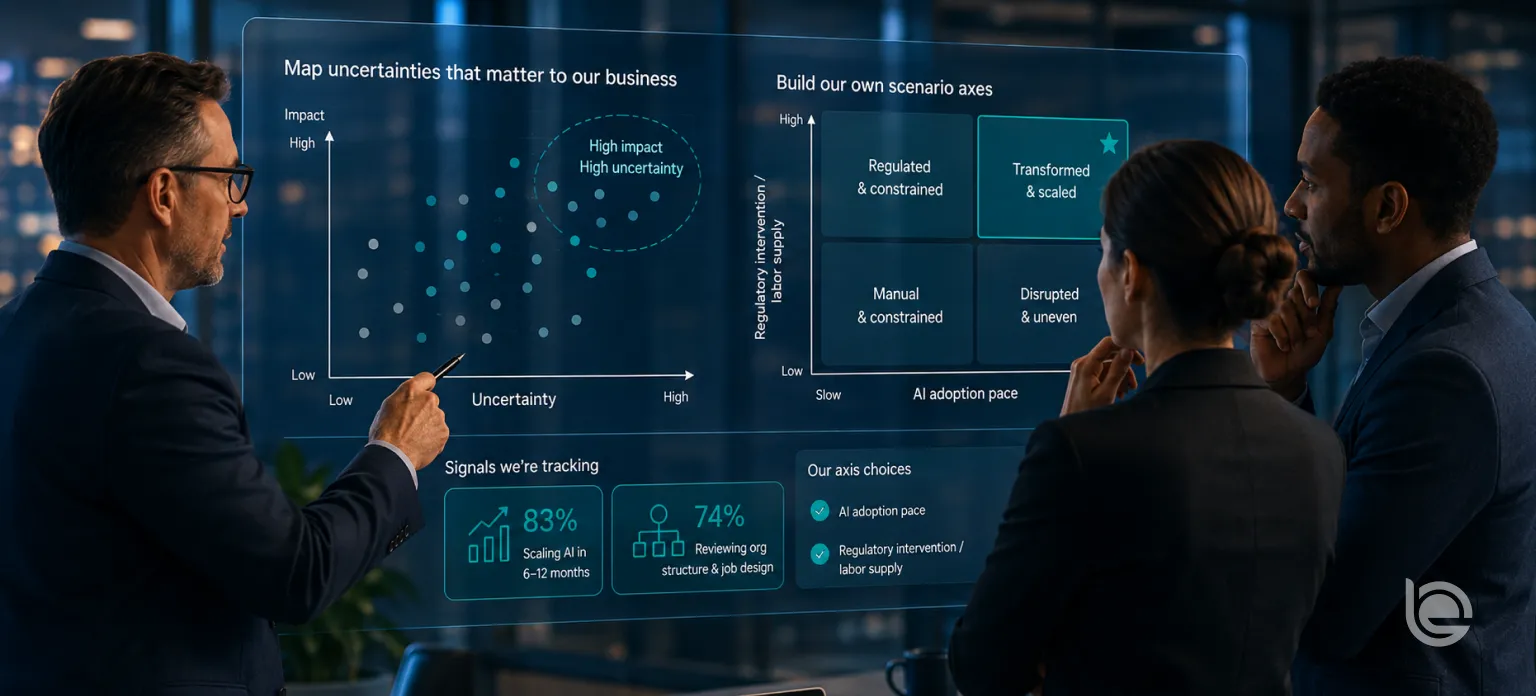
Use WEF’s four futures to explain the method to your board, not as your scenarios. Their axes are calibrated to the global economy. Yours need to reflect the two uncertainties that would most change your workforce decisions.
A usable axis meets four tests. It is genuinely uncertain over your horizon. It is largely outside your control, because things you control are choices, not scenarios. Different values along it change headcount, skill mix, location or cost structure enough to matter. And it is independent of your other axis, or the quadrants collapse into two.
Ask your top team to list every uncertainty that could materially change the workforce plan over three years, aiming for twenty to thirty, then plot each on impact against uncertainty. The high-impact, high-uncertainty cluster is your candidate pool.
One axis will usually be AI capability or adoption pace. The second is where the thinking happens, and it is rarely another technology variable. WEF’s Chief People Officers’ Outlook from May 2026, covering more than 140 people leaders at large global employers surveyed between 15 January and 2 March 2026, found the top named workforce disruptions were government labor market interventions such as localization quotas, migration and visa restrictions, and cyberthreats and data breaches. Not AI. The WEF Chief People Officers’ Outlook is a useful check on where people leaders see risk. Other candidates: labor supply in your critical skill pools, regulatory intervention in your largest markets, demand volatility in your core business.
The same survey found reviewing organizational structure and job design is now the number one workforce priority at 74%, and 83% expect to be scaling AI deployment within 6 to 12 months. If scaling is that close for that many, adoption pace is less uncertain over one year and more uncertain over three. Set your horizon accordingly.
Four scenarios, not five
Run four. Two axes, four quadrants. This is not aesthetic preference.
Three scenarios become good, bad and middle, and everyone plans for the middle. Five or more exceed what a leadership team can hold at once, so people quietly ignore the least plausible, which returns you to a single forecast with extra steps. Four quadrants have a property the others lack: no scenario is the average of the others, so there is no middle to default to. Give each a name people can say in a meeting, specific to your business, and not one that signals which you favor.
Writing scenario narratives planners can act on
Most scenario documents read like futurist essays that nobody can act on.
A usable narrative runs one to two pages and contains six things. The logic, what has to be true for this world to exist, in three sentences. The numbers: three to five quantified parameters such as headcount range, critical skill availability, external hiring cost, attrition and the share of work redesigned. The early signals you would see in the first six to twelve months. The implications: which roles grow, shrink or change shape. The stress point, what breaks first in your current operating model. And the decision, the one workforce choice you would make differently here than in the other three.
If you cannot write that last line, the scenario is not distinct enough: merge it or redraw the axes. Write all four before evaluating any, and assign each to a different author. Scenarios written by one person in sequence drift toward each other.
Sorting your moves: no-regret, options, bets
This is the payoff, and the part most teams skip. Take every workforce action on the table and sort it into three buckets.
No-regret moves pay off in all four scenarios. Fund them now. The clearest candidate is role-level task analysis of your highest-exposure functions: in a fast-AI world you need it to redesign work, and in a slow-AI world you need it because it is the analysis that would have prevented Orgvue’s 23% of layoffs made on general assumptions. Internal mobility capability is another, valuable if AI displaces tasks, if labor supply tightens, or if neither happens. Deliberate slack capacity qualifies too, which is why Deloitte’s 8% progress figure is such a costly gap.
Option-creating moves cost a little now and buy the right to act later, like a contingent arrangement you can scale up or down, or a skills taxonomy that re-cuts the workforce by capability rather than job title, which McKinsey’s finding on skills spanning automatable and non-automatable work makes essential. Deloitte’s parallel experiments are option-creating by design: you pay for information, not outcome.
Bets pay off in one or two scenarios and are expensive to reverse. Permanent headcount reduction in a function is a bet, as is consolidating a location footprint or a deep single-vendor commitment. Bets are how organizations win, but each needs a named owner, a stated scenario dependency, and a pre-agreed reversal cost. Never approve a bet presented as a no-regret move. That misclassification produced the 32% rehire rate.
Put the optimistic case in front of your executive team too. PwC’s 2026 Global AI Jobs Barometer, published 15 June 2026 and built on more than one billion job advertisements across 27 countries, found AI-exposed companies grew labor productivity 34% between 2018 and 2025 versus 24% for least-exposed firms, headcount at superstar AI-exposed firms grew 52% versus 36% at least-exposed firms, and the wage premium for AI skills reached 62%, up from 57%. The most AI-intensive firms grew headcount faster, not slower. The PwC 2026 AI Jobs Barometer is the strongest evidence for a Supercharged Progress world.
The base rate in compensation data is calmer still. Mercer’s 2026 US survey, fielded 20 to 31 October 2025 across 1,013 US organizations, found only 9% plan headcount changes related to AI and only 2% cite AI or automation as a reason for reduced hiring. See Mercer’s 2026 salary increase research.
Triggers, thresholds and the replan
Scenarios without triggers are a workshop. Triggers make them a system.
For each scenario, pick three to five indicators you can observe on a defined cadence, from a defined source, with a threshold that fires a specific action. An indicator without a threshold is a dashboard, and a threshold without a named action is a conversation.
Good triggers are external where possible, because internal metrics mostly confirm what you already chose. They are observable monthly or quarterly, carry a numeric threshold set in advance, which is the only time you can set it honestly, and are owned by a named person who reports the reading whether or not it crossed.
Workable examples: time to fill for your five most critical roles against your trailing twelve-month baseline; internal fill rate above a given level; voluntary attrition in your highest-exposure job families by tenure band; AI-attributed cuts in the monthly Challenger series, where a sustained move above the current 24% share suggests one world and a decline another; and entry-level hiring volume in your own AI-exposed functions, the internal analogue of the Stanford finding.
Set thresholds from your trailing baseline plus a tolerance band, not a round number that feels serious. Two consecutive readings outside the band should fire the replan, because single-period noise trains teams to ignore the alarm.
Write the action next to the threshold. “If entry-level offer conversion in Function X falls more than 20% below the trailing twelve-month average for two consecutive quarters, the CHRO convenes a scenario review within 30 days and brings a revised three-year plan.” That is a trigger. Anything vaguer is a wish.
Avoiding the pull toward the middle
Even with four scenarios, teams gravitate to whichever feels most reasonable. Three habits stop it.
Assign advocates. Each scenario gets an owner whose job in every review is to argue that world is arriving. Rotate them annually.
Ban probability weighting in the first pass. Assign probabilities and you have rebuilt a point forecast, because the weighted average is what survives into the plan.
Test every proposed action against all four scenarios in writing. If a paper names only one, send it back. This rule keeps the discipline alive after the workshop energy fades.
A worked structure you can copy
- Framing. The decision the scenarios inform, the horizon, the population in scope, and the date of the next review.
- Axis selection. The uncertainties surfaced, the impact and uncertainty plot, the two chosen axes with a low and high end each, and one paragraph on why each runner-up was rejected.
- The four scenarios. For each: name, logic, three to five quantified parameters, early signals, role implications, stress point, and the one decision you would make differently.
- Move classification. One table with every action sorted into no-regret, option-creating and bet, each with an owner, a cost, a decision date, and for bets the scenario dependency and reversal cost.
- Trigger register. Per indicator: source, cadence, owner, threshold, consecutive-reading rule, and the action that fires.
- Review log. Date, readings against every threshold, what changed, and any scenario redrawn. It is the only record of whether your judgment is any good.
Review the trigger register quarterly, as a reading exercise rather than a rewrite. Review the scenarios annually, and redraw the axes only when one has resolved, a new uncertainty has entered the high-impact cluster, or a trigger has fired twice.
All of this depends on modeling structure and cost under multiple assumptions without rebuilding the spreadsheet each time. Configurable what-if modeling by business unit, division or location, of the kind in BullseyeEngagement’s workforce planning software, keeps four parallel scenarios maintainable. The version you can refresh quarterly is the one that gets used.
What to do next
Pick your two axes this quarter. Write four scenarios, one page each. Sort every workforce action into no-regret, option and bet, and fund the no-regret column now. Set five triggers with numeric thresholds and named owners. Put the quarterly review in the calendar before you leave the room.
For a second angle, our work on workforce planning in the age of AI covers the modeling side, and how AI can enhance rather than replace the human workforce covers the job design question WEF’s chief people officers rank first. When you’re ready to model this against real data, talk to our team.
Frequently asked questions
What is workforce scenario planning?
Workforce scenario planning builds several internally consistent views of the future workforce rather than one forecast, then identifies which actions pay off across all of them. It replaces “what will happen” with “what would we do differently in each world, and what should we do anyway.”
How many workforce scenarios should we plan for?
Four. Two axes of uncertainty produce four quadrants, and no quadrant is the average of the others, so there is no middle to default to. Three collapse into good, bad and middle. Five or more exceed what a team can genuinely compare.
Does the WEF say AI will cut 41% of jobs?
No. WEF’s Future of Jobs Report 2025 says 40% of employers anticipate reducing headcount where AI automates tasks, alongside 85% planning upskilling and a net projection of 78 million more jobs by 2030. The 41% is WEF’s press release rendering of the same finding.
Is AI actually causing job losses right now?
The evidence splits by level. Yale’s Budget Lab and the OECD Employment Outlook 2026 find stability economy-wide. Stanford’s Digital Economy Lab, updated 12 August 2026, finds employment of 22 to 25 year olds in AI-exposed occupations 19% below trend, through reduced hiring rather than layoffs.
What is a no-regret move in workforce planning?
A no-regret move pays off in every scenario, so you fund it without waiting for the uncertainty to resolve. Role-level task analysis, internal mobility capability and slack capacity qualify. The test is whether you would be glad you did it in the scenario you consider least likely.
Start with the reversal rate
If you take one number into your next planning session, make it Orgvue’s 32%. Not because it settles anything about AI, but because it is the clearest evidence that confident workforce decisions built on unconfident forecasts get reversed at an expensive rate.
Scenario planning does not make you right. It makes being wrong survivable, which over three years is the more valuable property. The organizations that come through well will not be the ones that predicted correctly. They will be the ones that stayed able to change their minds.