Sixty percent of nominating and governance committee chairs at S&P 500 companies rank CEO succession as the second most important item on their committee agenda, up 10 points in a single year. Sixty-nine percent of those same chairs spend 10 hours or less a year on it. Both figures come from the Spencer Stuart 2025 US Board Index, and the gap between them is the problem you have been handed.
Directors know it. The NACD 2026 Governance Outlook, from a survey of more than 24,000 NACD members released in December 2025, names CEO succession planning as the single most important board practice needing improvement in 2026. Not the most important practice. The one most in need of repair.
What changed this year is who the research says closes that gap. Not a new committee charter or a longer meeting. A specific person: an engaged CHRO who owns the design of the process. That is a promotion and a liability in the same envelope.
This piece covers what your board needs from you on the CHRO role in CEO succession, the ten documented pitfalls, and an operating model: cadence, artifacts, candidate exposure, external benchmarking, and how to handle a CEO who would rather not discuss it.
The contradiction sitting at the center of the board agenda
Across the S&P 500, in the proxy year running from May 2024 to April 2025, CEO succession climbed to second place on the nominating and governance committee agenda for 60% of chairs, a 10-point rise in a year. Yet 69% of those chairs spend 10 hours or less annually on it, roughly one working day. Committees are not lying about priority. They are describing an intention they have not yet resourced.
Two more figures complete the picture. Fifty-five percent say their board actively supports CEO succession activities, leaving nearly half where support is passive at best. And 84% have a formal emergency plan or an identified interim successor from management or the board.
That last number is often mistaken for good news. Emergency coverage answers who signs on Monday if something happens Sunday. It says nothing about whether the successor you would appoint deliberately, after a year of assessment against a forward strategy, exists at all. High stated priority, thin time, emergency coverage masking weak deliberate planning: each is a process design problem, which is why the research keeps landing on your desk.
Carry the second NACD finding into every board conversation this year. Directors name workforce adaptability, organizational agility and skilled-employee shortages as the top barriers to executing strategy, while more than 60% cite strategy execution as their top oversight improvement area. They have already concluded that people capability stands between strategy and result. You are not arguing for relevance. You are being handed a mandate to structure.
Why the research points at the CHRO role in CEO succession
The most rigorous recent work on this is “CEO Succession: 10 Pitfalls Boards Must Avoid, and the CHRO Practices That Help”, published by the HR Policy Association and the Center for Executive Succession at the University of South Carolina’s Darla Moore School of Business, on the Harvard Law School Forum on Corporate Governance in July 2025. The research base: 26 directors of large multinationals, 8 institutional investment leaders, 10 executive search and consulting leaders, plus 49 directors surveyed.
The companion article in Harvard Business Review, published November 2025 by Ani Huang, Anthony Nyberg and DJ Schepker, states the conclusion plainly. Successful succession processes share one element: a trusted and engaged CHRO who brings structure, objectivity and clarity.
HR Executive’s coverage of the same research, published February 2026, goes further. Boards now identify the CHRO as more critical to certain stages of CEO succession than the outgoing CEO, including ownership of process design. That is a real shift in how directors describe the division of labor.
Now the uncomfortable half. Gartner research published in February 2025, from a survey of 200 CxOs in October 2024, found 56% of C-suite leaders are likely or extremely likely to leave within two years, and 27% within six months. The same survey found fewer than 25% of CxOs say their CHRO is effective at strengthening C-suite cohesion, and 23% say the CHRO manages tension between C-suite members effectively.
Read those together and the assignment sharpens. Your peers are unstable as a group, and most do not currently credit HR with holding that group together. Accept process ownership without first building visible objectivity and you inherit the politics of a fragile executive team without the trust to survive it. Credibility comes from the mechanics of the process, not a board deck.
The ten pitfalls, grouped into four failure modes
The research names ten pitfalls: CEO hesitation, reactive succession, misaligned CEO profiles, ceding process power to the sitting CEO, shallow board discussions, limited internal talent insight, poorly managed transitions, development disruption from stretch assignments, preordained successors and frontrunner bias, and superficial external candidate evaluation. As a checklist, that is easy to nod at and hard to use. Grouped by what breaks, it becomes diagnostic.
Failure mode one: the process never genuinely starts
Three pitfalls cluster here: CEO hesitation, ceding process power to the sitting CEO, and shallow board discussions.
The quantified finding is stark. Only 41 of 71 directors reported CEO eagerness for succession planning, and boards with strong succession practices showed 70% CEO engagement against 28% in less focused boards. The difference between a working process and a stalled one is largely whether the incumbent leans in.
Just 35% of directors believe their board has ample time for succession work, matching the Spencer Stuart 10-hour finding from another angle. Shallow discussion is rarely a competence problem. It is a calendar problem compounded by the awkwardness of debating a successor in front of the person being succeeded.
The trap runs both ways. If the process belongs to the CEO, it moves at the CEO’s comfort level and the profile drifts toward the incumbent’s strengths. If it visibly excludes the CEO, you lose the richest source of insight on internal candidates. The answer is separating roles, not exclusion.
Failure mode two: the target is never properly defined
Reactive succession and misaligned CEO profiles sit together. The finding that should worry any CHRO: 72% of boards analyzed future strategy, but only 58% aligned the CEO profile accordingly.
That 14-point drop is where good intentions leak out. Boards do the strategy work. Then the specification for the next CEO quietly reverts to a description of the current one with adjectives added. Reactive succession is what happens when the step is skipped and the search begins after the departure is announced, with the profile written under pressure by people who need an answer rather than the right answer.
Failure mode three: the pipeline is never truly seen
Four pitfalls cluster in the middle: limited internal talent insight, development disruption from stretch assignments, preordained successors and frontrunner bias, and superficial external candidate evaluation.
The signal is clear. Boards with strong succession practices identified internal candidates 100% of the time, against 72% in weaker boards. More than a quarter of the time, the weaker boards had nobody named.
The companion pitfalls explain why identification alone is not enough. Stretch assignments are the main development mechanism for CEO-ready leaders and also the main way a promising executive gets damaged, moved into a role that tests the wrong things. Frontrunner bias sets in when one name is repeated often enough that the process becomes ratification. Superficial external evaluation produces a comparison set that exists only to validate the internal favorite. Each is a data problem before it is a judgment problem. Directors cannot correct for frontrunner bias if the only evidence they see is a slide the CEO narrated last quarter.
Failure mode four: the handover is treated as an event
The last cluster is one pitfall with outsized consequence: poorly managed transitions. Board confidence in managing transitions averaged 2.8 out of 5. Only 42% of strong boards had formal transition plans, against 12% of weaker boards. Even among boards doing this well, fewer than half have a written plan for a new CEO’s first months.
This is the most fixable gap on the list. A transition plan is an artifact. It can be drafted, reviewed and approved in one committee cycle, long before anyone needs it.
The perception gap that makes this urgent
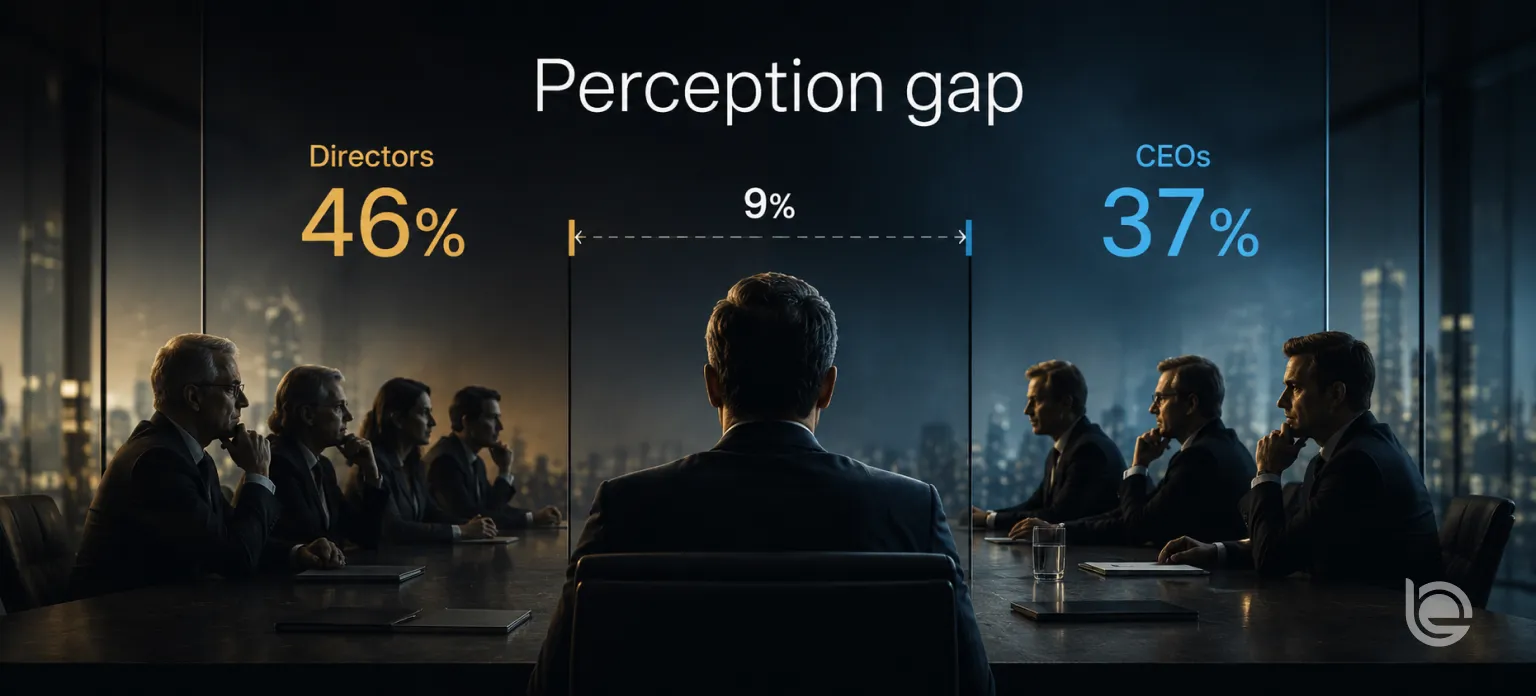
Heidrick & Struggles’ Route to the Top US 2026, based on 1,033 CEOs and board members globally including 253 in the US, adds a dimension the governance surveys miss. More than a third of US companies do not have a CEO with the capabilities needed for near-term success. The detail that matters most is who believes it. Forty-six percent of directors report a gap between the capabilities the business needs and the current CEO’s strengths, against 37% of CEOs. Directors see the shortfall more often than the person in the seat does.
That nine-point spread is the political weather every succession conversation happens in, and it explains CEO hesitation without attributing bad faith to anyone. A CEO who perceives no capability gap experiences succession planning as a solution to a problem that does not exist.
Two more Heidrick findings frame the work. Only 25% treat CEO succession planning as a priority, one-third lack specific KPIs for evaluating its effectiveness, and a quarter of leaders are sure their processes are missing future leaders.
The earlier Route to the Top 2025 detailed survey insights quantifies what changes the outcome. Heidrick segments respondents into continuous succession strategists, as-needed traditionalists and reactive thinkers. Ninety percent of continuous strategists feel well positioned, against 35% of reactive thinkers. Only 29% overall are very confident their CEO succession strategy positions them well.
The variable is cadence, not effort. Continuous strategists work on succession constantly, in small increments, so no single meeting carries the weight. That is a design choice a CHRO can make.
A board that will not assess itself will not assess your pipeline well either
There is a structural reason boards struggle here, and it shows up in the PwC 2025 Annual Corporate Directors Survey. Fifty-five percent of directors say at least one fellow director should be replaced, the highest in the survey’s history. Seventy-eight percent say assessments do not capture the full picture of board performance, and nearly 75% of boards skip individual director reviews. Only 32% of executives believe their board has the right skills mix.
A board that avoids individual performance conversations about its own members will find the same conversation about CEO candidates equally uncomfortable. The muscle is the same. If your directors have never sat through a rigorous assessment of a named individual, do not expect them to run one on your succession slate without scaffolding. Supply the framework, the consistent evidence and a discussion format that keeps directors on capability rather than personality, and you are solving a problem the board already knows it has.
What is actually driving the pressure, and what is not
Be precise here, because CHROs are being told otherwise. There is no new SEC rule in 2025 or 2026 requiring CEO succession planning disclosure. None. If you have heard that a regulatory mandate applies, it is wrong, and repeating it to your board will cost you credibility the moment general counsel checks.
The real pressure is commercial and reputational. Debevoise & Plimpton’s “Key Considerations for the 2026 Proxy Season”, on the Harvard Law School Forum on Corporate Governance in January 2026, notes that CEO transitions remain an area of significant investor attention and media scrutiny, and advises companies in transition to align incoming, outgoing and interim CEO compensation with market practice and explain transition-award rationale in the compensation discussion and analysis.
The pressure comes from four places: institutional investors who ask about succession in engagement meetings, proxy advisors who factor governance quality into recommendations, activists who treat a weak bench as an opening, and NACD norms that set what directors consider standard practice. That is a stronger set of incentives than a disclosure rule, because it operates continuously. Frame it that way. You are not helping your board comply. You are helping them hold a position under questioning.
The operating model: cadence, artifacts and who owns what
Everything above is diagnosis. Here is the design.
Set a four-touchpoint annual cadence
Ten hours a year fails because it arrives as one meeting. Spread the same time across four touchpoints and the process becomes continuous.
Touchpoint one, after the strategy session. Sixty minutes with the nominating and governance committee to translate the approved strategy into required CEO capabilities. No candidate names in the room. The output is the specification.
Touchpoint two, mid-year. Ninety minutes on the internal slate: readiness movement, assessment evidence, development progress, retention risk. Candidate names, no ranking discussion.
Touchpoint three, in executive session without the CEO. Forty-five minutes for directors to discuss the slate candidly and review the external market benchmark. This is the structural answer to ceding process power. The CEO contributes fully at touchpoints one and two, and is absent here.
Touchpoint four, annually. Review and reapprove the emergency succession plan and the transition plan, converting emergency coverage into something that has actually been tested.
Four touchpoints, roughly five hours of committee time plus your preparation. That fits the budget most committees already have, and turns one annual event into a running conversation.
Build the succession dashboard the committee sees
The committee should receive the same one-page dashboard every cycle, with the same fields, so changes are visible over time. At minimum: the CEO specification with capability ratings for each internal candidate against it; readiness horizon as ready now, one to two years, or three or more; assessment evidence and dates; development actions in flight with owners; retention risk flags; the external market view; and emergency coverage status.
This is where AI Advisor strengthens the board view. Instead of relying on disconnected decks or once-a-year updates, leaders can see successor rankings, readiness horizons, development actions, and exposure risks in a more current and structured way.
Consistency is the point. Identical fields make a candidate who has been “two years out” for four straight years impossible to miss. Because the data has to hold competency ratings, performance history, risk assessment and successor mapping in one place rather than across disconnected decks, this suits succession planning software with a consolidated talent profile and interactive nine-box, and leadership dashboards built for board-level reporting when the committee wants movement across cycles rather than a snapshot.
Write the CEO specification from forward strategy, not from the incumbent
The 72% versus 58% finding is a process defect with a process fix. Build the specification in a session that structurally cannot reference the incumbent. Start from the approved strategy and ask the committee three questions. What will this business have to be good at in three to five years that it is not reliably good at today? Which of those capabilities must sit in the CEO rather than being buyable elsewhere on the executive team? What must be true about the next CEO for the riskiest element of the strategy to succeed?
Write the answers as six to eight capability statements with observable behavioral indicators. Then, and only then, run the incumbent against the same specification as a calibration exercise. Specification first, people second. Reversing that order is how you get a profile describing the person leaving. Reapprove it annually, because a two-year-old profile is a reactive process wearing a proactive label.
Structure director exposure to internal candidates deliberately
Directors cannot form independent judgments from curated presentations. Give each serious candidate a substantive board agenda item annually, on a topic inside their accountability where directors can ask real questions. Rotate committee attendance so different directors see different candidates. Use small-group settings such as a dinner or site visit, because directors read people differently outside the boardroom. Pair every exposure with independent evidence: external assessment, structured 360 input and performance data.
Two guardrails matter. Sequence exposure so no single candidate accumulates disproportionate airtime, which is how frontrunner bias forms. And debrief directors individually rather than as a group, because group discussion converges quickly and you want the variance. The same discipline applies one level down, in the pipeline feeding this slate, which is where a defensible method for identifying high-potential employees does most of the work.
Run a real external benchmark without signaling no confidence
Superficial external evaluation and internal anxiety are two sides of one problem. The fix is to make benchmarking routine and to say so.
Establish the external market scan as a standing annual input, not an event triggered by doubt, and state its purpose in the committee charter: to calibrate the internal slate against the available market, so internal candidates are measured against a real bar rather than each other.
Keep it at profile level in normal years. Anonymized market maps, capability distributions, compensation benchmarks. Named approaches belong only in an active search. Apply the same assessment instruments to external profiles that you apply internally, because a comparison using different evidence on each side is not a comparison. Tell internal candidates the scan exists and why. Executives assume it is happening anyway, and confirming it costs less trust than being discovered.
Handle CEO hesitation without a confrontation
Given the 70% versus 28% engagement finding, this is the most consequential relationship you manage. Three moves help.
First, separate the roles out loud. The CEO owns developing the executive team. The board owns selecting the successor. You own process design. Stated early and repeated, that removes the implication that succession planning is a referendum on tenure.
Second, give the CEO a defined role: development sponsorship, assignment design, candid capability input. A CEO with real work in the process resists it less than one who is merely observed.
Third, use the Heidrick perception gap as neutral ground. Forty-six percent of directors seeing a capability gap against 37% of CEOs is a published finding about a population, not an accusation. It opens the conversation about what the business needs next without anyone having to say the incumbent falls short.
If hesitation persists, escalate through the committee chair rather than absorbing it. Your standing will not survive being the only person who wants this to happen.
Frequently asked questions
What is the CHRO’s role in CEO succession planning?
The CHRO owns process design: the cadence of board discussions, the CEO specification, the assessment framework, the succession dashboard and the transition plan. The board owns selection and the CEO owns executive development. Harvard Business Review research from November 2025 found successful processes share a trusted, engaged CHRO bringing structure and objectivity.
How often should a board discuss CEO succession?
At least quarterly, in short focused sessions rather than one annual review. Spencer Stuart’s 2025 US Board Index found 69% of nominating and governance chairs spend 10 hours or less a year on it. Heidrick’s 2025 research found 90% of continuous succession strategists feel well positioned, against 35% of reactive thinkers.
Does the SEC require companies to disclose CEO succession plans?
No. There is no SEC rule in 2025 or 2026 mandating CEO succession planning disclosure. Pressure comes from institutional investors, proxy advisors, activists and NACD governance norms. Debevoise & Plimpton’s January 2026 proxy season guidance notes that CEO transitions remain an area of significant investor and media scrutiny.
What should be in a CEO succession dashboard for the board?
The approved CEO specification, capability ratings for each internal candidate against it, readiness horizon, assessment evidence and dates, development actions with owners, retention risk flags, an external market view and emergency coverage status. Keep the format identical every cycle so slow movement becomes visible.
Why do so many boards have emergency plans but weak succession plans?
Spencer Stuart’s 2025 US Board Index found 84% of boards have a formal emergency plan or identified interim successor. Emergency coverage answers who steps in immediately. It does not test whether a deliberately developed successor exists. The two require different work, and the first is often mistaken for the second.
Where to start this quarter
You do not need board approval to begin. Three things are inside your control.
Draft the CEO specification from the current approved strategy, before anyone asks. Six to eight capability statements with behavioral indicators, brought to the committee chair as a working document rather than a finished product.
Build the one-page dashboard and populate it with whatever evidence exists today, including the gaps. Honest blanks are more useful to directors than a polished page implying coverage you do not have, and they make the case for investment better than any argument you could write.
Then write the transition plan. Given that only 42% of the strongest boards have one, this is the fastest route into the top tier of a practice directors named their number one improvement priority for 2026. It costs one committee cycle and is the artifact most likely to matter on the day it is needed.
If you want readiness, competency, and risk data across the executive layer in one place, BullseyeEngagement’s AI Advisor helps leaders identify and rank successors, assess readiness timelines, evaluate bench strength, build development plans, and flag exposure risk for critical roles.
The operating model still comes first. AI Advisor makes that model more visible, current, and actionable