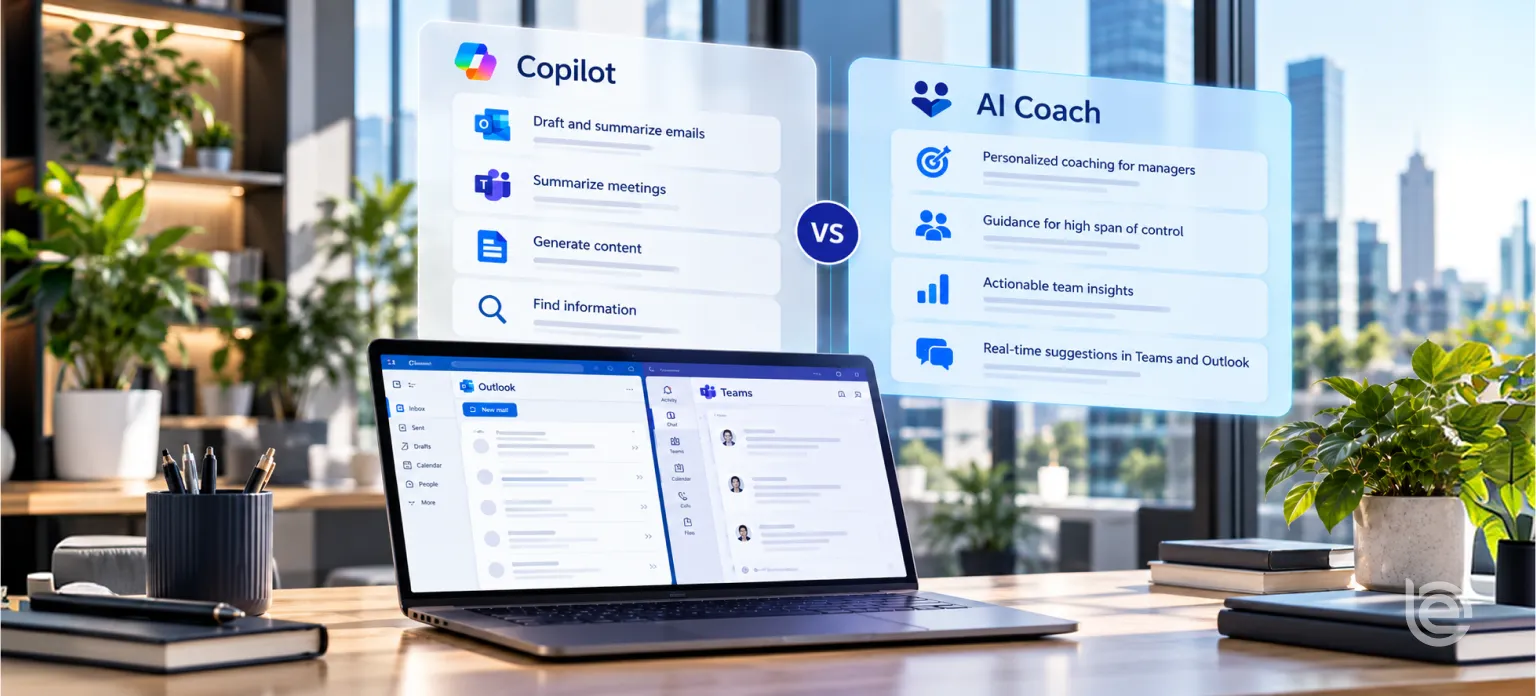
AI coaching for managers gives each manager real-time, personalized guidance for feedback, performance conversations, development discussions and team communication, inside the tools they already use. It becomes especially valuable as teams get larger. US managers now average 12.1 direct reports, and as spans widen, preparing thoughtfully for every conversation becomes harder. AI Coach helps close that gap by turning psychometric insight into practical coaching guidance for the individual in front of the manager.
Key takeaways
- Average US span of control rose from 10.9 to 12.1 direct reports in a single year, according to Gallup.
- Almost every manager also carries individual contributor work, so time for coaching is shrinking as teams grow.
- Weekly meaningful feedback is one of the strongest habits managers can protect as teams grow. Gallup finds that employees who strongly agree they received meaningful feedback in the past week are far more likely to be engaged, regardless of team size.
- AI Coach helps managers prepare for those conversations by turning each person’s behaviors, motivators and work energizers into practical coaching insight.
The span of control gap in numbers
Gallup’s latest research on team size is blunt. The average number of people reporting to a US manager climbed from 10.9 in 2024 to 12.1 in 2025. That’s a rise of nearly 50% since Gallup started tracking in 2013.
The average hides a split. Gallup found that most managers still lead small teams, with a median of about 5 to 6 people. Around 22% of managers have 10 to 24 direct reports, and 13% oversee 25 or more. The growth in those very large teams is what pulls the average up.
The span of control problem is not evenly spread. Most managers still lead relatively small teams, while a minority carry very large spans. That makes it important to look at the distribution inside your own organization rather than treating 12.1 as a universal target or limit.
Now add the workload. In Gallup’s US study, 97% of managers said they have individual contributor responsibilities on top of leading people, and the median manager spends 40% of their time on that individual work. A manager with 14 direct reports and 40% of the week spent on their own deliverables has roughly 24 hours left for everything else: meetings, hiring, admin, escalations and coaching.
Gartner’s data shows how that feels from the inside. At its HR Symposium in late 2025, Gartner shared that almost 80% of CHROs believe managers are overwhelmed by the growing scope of their responsibilities.
Why large teams break the coaching habit first
When a manager runs out of time, the first thing to go is the thing with no deadline. Coaching has no deadline.
The feedback math
Gallup’s research points to a single habit that matters more than most: providing meaningful feedback to each employee at least once a week. Gallup says this nearly triples the share of engaged employees. It also says the conversations don’t have to be long. Fifteen to 30 minutes, done consistently, is enough.
Here’s what that looks like at different team sizes.
| Direct reports | Weekly feedback at 15 minutes each | Weekly feedback at 30 minutes each | Share of a 40-hour week at 30 minutes |
|---|---|---|---|
| 6 | 1.5 hours | 3 hours | 7.5% |
| 12 | 3 hours | 6 hours | 15% |
| 18 | 4.5 hours | 9 hours | 22.5% |
| 25 | 6.25 hours | 12.5 hours | 31% |
The conversation time can look manageable on paper. The pressure comes from everything around it: preparation, context, follow-up and the need to adapt the conversation to the individual. As the number of direct reports grows, relying on memory alone becomes less reliable.
What happens when feedback goes generic
Without preparation, feedback turns into status updates. “How’s the project going?” “Any blockers?” Those questions are fine. They’re also the kind of conversation employees don’t remember.
Gallup found that among nearly 15,000 employees, only 16% said the last conversation with their manager was extremely meaningful. And the payoff from getting it right is large. Across 7 studies, Gallup found that about 7 in 10 employees were highly engaged, regardless of team size, when they strongly agreed they had received meaningful feedback in the past week. When they didn’t strongly agree, only 1 in 4 were engaged.
That finding matters for anyone planning around wider spans. Team size alone does not determine engagement; consistent, meaningful feedback remains a critical management practice across team sizes.
The friction that goes unnoticed
Large teams can also make interpersonal friction harder for a manager to notice early. With more relationships and more competing demands, signs of tension may be easier to miss until they begin affecting collaboration, delivery or retention.
New managers get hit hardest
New managers can feel this pressure acutely because they are still building the habits required for feedback, delegation, conflict and development conversations. When a first-time manager also inherits a wide span, structured support becomes more important, not less.
6 signs a manager’s span is too wide
Before you add any tool, confirm where the pressure sits. These signals show up in data you already have.
1:1s keep getting cancelled
Check-in records can reveal whether manager capacity is slipping. Rather than using a fixed cutoff, watch for a sustained decline in scheduled 1:1 completion, repeated cancellations or long gaps between conversations. Those patterns are a prompt to examine workload, span and manager support.
Engagement splits by team size
Segment engagement results by span-of-control bands that fit your organization. If wider-span teams consistently score lower on feedback, manager support or development items, investigate whether manager capacity and conversation quality are contributing factors.
Escalations skip the manager
If employees increasingly bypass the manager and take issues directly to HR or a skip-level leader, treat it as a signal worth investigating. It may reflect capacity, trust, role clarity or another team issue; HR case patterns can help identify where a closer look is needed.
Reviews read the same
Review quality can also expose capacity pressure. If written reviews become unusually brief, repetitive or focused only on task status, managers may need better preparation support, better year-round notes, or more time for the process.
New hires leave early
Compare onboarding and 90-day retention by team size and manager. Early exits on wider teams do not prove that span is the cause, but they can reveal where new employees may not be receiving enough manager attention or support.
The manager’s own engagement drops
Gallup’s 2026 State of the Global Workplace data show global manager engagement fell from 31% in 2022 to 22% in 2025. Watch your own wide-span managers for similar pressure. A manager who is disengaged or overloaded will have less capacity to coach consistently and may need workload, role-design or development support.
No single signal proves a span is too wide. But when several of these patterns appear on the same team, review the role design: direct-report load, individual contributor work, manager capability and available support. AI coaching can help managers use limited preparation time better, but it should not be used as a substitute for fixing an unsustainable role.
Building the business case for AI coaching
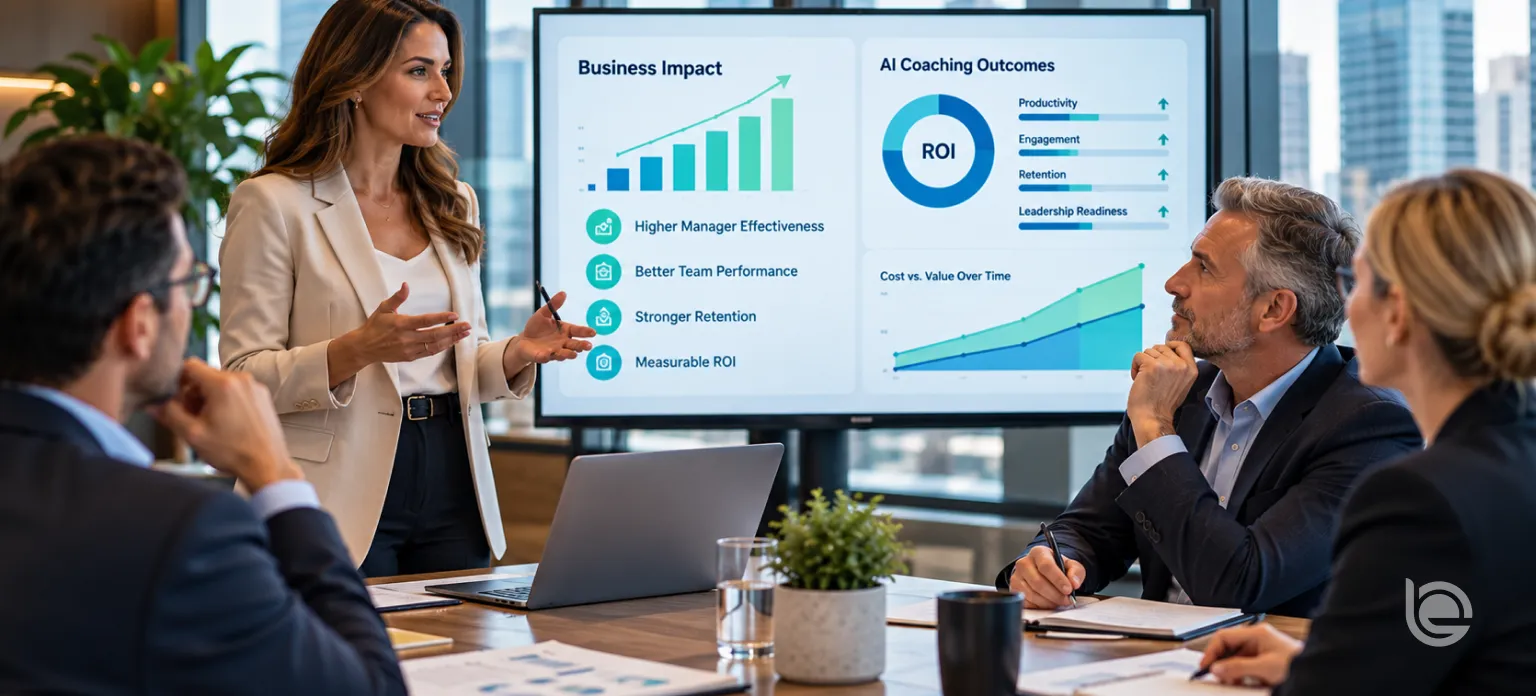
Leaders will ask what they get for the spend. Keep the case tied to outcomes they already track.
- Engagement. Gallup’s finding is the anchor. Employees who strongly agree they received meaningful feedback in the past week are highly engaged about 7 in 10 times, compared with about 1 in 4 for everyone else. If AI coaching moves even a slice of your large-team employees into the first group, the engagement lift is measurable.
- Retention. Disengaged employees leave more often, and replacing them costs money. Use your own cost-per-hire and time-to-productivity figures. Multiply by the number of avoidable exits from wide-span teams last year. That’s the pool of cost AI coaching is trying to reduce.
- Manager capacity. Use an illustrative time-saved estimate rather than assuming a fixed ROI. If a manager with 14 direct reports saves 10 minutes of preparation per person in a week, that is about 2 hours and 20 minutes returned to the manager. Across 40 managers with similar spans, the potential capacity gain would be more than 90 hours a week. Validate the actual time saved during the pilot.
- Manager retention. Wide-span managers may be difficult and costly to replace, especially after a restructure. Use your own manager turnover, time-to-fill and ramp-time data to quantify the value of reducing avoidable overload.
- Consistency and fairness. A structured coaching approach can help managers prepare more consistently across employees. Treat that as a quality and governance objective, and test whether feedback becomes more specific and consistent during the pilot.
Present the case as a pilot with clear measures. It’s easier to approve a 90-day test with 20 managers than a company-wide rollout on faith.
How AI Coach connects to the rest of the platform
AI Coach is most useful when it sits alongside the performance and development processes managers already use. Inside BullseyeEngagement, AI Coach is part of a broader platform that includes check-ins, goals, development plans, performance reviews and talent insights.
Managers can use Check-Ins for recurring 1:1s and use AI Coach to prepare for the conversation. Goals and OKRs provide measurable context for performance discussions, while development plans capture agreed growth actions. Better-prepared conversations can also improve the evidence managers bring into performance reviews.
The broader platform connection reaches succession planning too, but the products serve different jobs. AI Advisor helps leaders identify and rank successors, assess readiness and bench strength, and flag exposure and risk. AI Coach focuses on helping managers communicate, coach and develop people more effectively in day-to-day work.
What AI coaching for managers actually does
AI coaching can sound vague, so it helps to be precise about the role of AI Coach. BullseyeEngagement positions it as real-time guidance for feedback, performance conversations, development discussions and team communication, using psychometric insight to help managers lead with greater confidence and consistency.
The product page lists these capabilities:
- Real-time guidance for feedback, performance conversations and development discussions
- Psychometric-based communication guidance tailored to the individual
- Support for difficult conversations and team communication before issues escalate
- In-the-moment coaching that can help new managers build confidence and consistency
- Coaching insights grounded in behaviors, motivators and work energizers
- Development guidance that helps managers turn insight into more useful growth conversations
It works inside the tools teams already use, including Microsoft Teams and Outlook, so managers don’t need another app open.
The science underneath
BullseyeEngagement’s AI Coach combines AI with Humantelligence’s psychometric science. The 2025 partnership announcement describes the integration as bringing AI-powered coaching and behavioral science into Bullseye’s talent solutions to support manager effectiveness, development and collaboration.
The psychometric foundation starts with an assessment. According to Humantelligence, its assessment measures Behaviors, Motivators and Work Energizers in about 10 minutes. Those declared insights give AI Coach a structured basis for adapting coaching guidance to how a person tends to communicate, what motivates them and the conditions that energize their work.
Why this matters for large teams
A manager with 14 direct reports is unlikely to remember every person’s communication preferences and motivators in the moment. AI Coach makes those psychometric insights available when the manager is preparing for a conversation. The manager still decides what to say, how to say it and what action to take.
A weekly rhythm for managers of large teams
Tools only help if they fit into a routine. Here is an illustrative weekly rhythm for a manager with 12 to 18 direct reports. Adjust it to the type of work, the manager’s individual-contributor load and your organization’s operating cadence.
| Day | Manager action | How AI Coach supports it | Time |
|---|---|---|---|
| Monday | Review the week’s 1:1 schedule and team priorities | Review psychometric-based coaching guidance for the people meeting this week | 20 minutes |
| Tuesday to Thursday | Hold 1:1s in 15 to 30 minute blocks | Use communication-style and motivator insights to prepare for each conversation | 2 minutes per person |
| Tuesday to Thursday | Handle any tough conversation as it comes up | Use coaching guidance to plan the tone and structure; the manager decides the message | 5 minutes |
| Wednesday | Send written recognition for recent work | Use psychometric insight to tailor how recognition or appreciation is delivered | 10 minutes |
| Thursday | Check for team friction | Use communication and team-dynamic insight to plan how to address emerging friction | 10 minutes |
| Friday | Log development notes and next steps | Use Bullseye Check-Ins or development plans to document follow-ups; AI Coach supports the conversation | 15 minutes |
The rhythm has 2 goals. Every person gets a meaningful touchpoint every week, even if some are short. And the manager spends their limited prep time on the people and situations that need it most.
For very large teams, do not assume technology alone solves the capacity problem. Organizations may need a mix of full 1:1s, shorter meaningful touchpoints, team-based communication and role-design changes. Gallup’s evidence is about meaningful weekly feedback, not a requirement that every feedback interaction be a formal meeting.
What a personality-specific prep brief looks like
To make this concrete, here’s an illustrative example of how a manager might use AI Coach before 2 conversations on the same topic. The employees are invented. The point is the format.
The manager, Dana, runs a customer operations team of 14. Marcus and Priya, who sit on that team, both missed a deadline on a shared process update. Dana wants to address it with each of them this week.
Prep for Marcus. Marcus’s profile suggests he’s direct, moves fast and values autonomy. Guidance for Dana: state the issue in the first minute, skip the warm-up, focus on the outcome that was missed and ask Marcus how he’d prevent it next time. Avoid prescribing a detailed fix, since he’ll respond better to owning the solution.
Prep for Priya. Priya’s profile suggests she’s careful, values stability and prefers clear expectations. Guidance for Dana: start by acknowledging the quality of her recent work, then explain the deadline impact calmly. Ask what got in the way, since she may have been waiting on information. Agree on a specific checkpoint before the next deadline.
Same issue, same manager, 2 very different conversations. Without the prep, Dana would probably have had the same conversation twice. One of them would have landed badly.
This is the core argument for AI coaching on large teams. The manager doesn’t need a script. They need a quick, reliable read on how each person will hear the message.
Where AI coaching helps most on a large team
Some situations benefit more than others. These are the moments where AI Coach earns its place for a manager with a wide span.
Performance conversations that could go wrong
Tough conversations are where preparation matters most. Guidance on structure, tone and communication preferences can help a manager plan a more thoughtful conversation while keeping the actual performance judgment and message with the manager.
Recognition that doesn’t feel generic
Recognition is not experienced the same way by everyone. Psychometric insight can help a manager think about whether a person is more comfortable with public recognition, private acknowledgment or a different style of appreciation, instead of defaulting to one approach for the whole team.
Conflict between team members
AI coaching can help a manager prepare for friction by adapting how they approach the conversation and by offering a structured way to think through communication differences. The manager remains responsible for understanding the actual situation and deciding how to intervene.
Onboarding new team members
Once a new team member has completed the psychometric assessment, AI Coach can give the manager additional context on communication and work-style preferences. That can make early conversations more intentional, especially when the manager has limited time across a large team.
Goal-setting that motivates
Goals still need to be set around business outcomes. AI Coach can help a manager discuss those goals in language that reflects the employee’s motivators and work style, while Bullseye OKRs provides the structure for tracking objectives, key results and progress.
Emails and written feedback
Because AI Coach is available in tools such as Outlook and uses communication-style insight, it can support managers as they prepare written feedback and messages. The manager should still verify the substance, context and final wording before sending.
What AI coaching can’t fix
It’s worth being honest about limits. AI coaching supports managers. It doesn’t redesign their jobs.
- It cannot create time that is not there. If a manager carries a very high individual-contributor workload and a very large team, coaching support may improve preparation but will not solve the underlying capacity problem. The bigger fix may be fewer direct reports, less individual work, clearer delegation or another layer of support.
- It cannot replace management talent. Gallup’s research finds that managers with stronger management talent hold up better as spans and individual-contributor workloads increase. AI Coach can support a manager’s preparation and development, but role selection still matters. Use your succession and selection process to put the right people into wide-span roles. Our guide on identifying high-potential employees covers how.
- It can’t make decisions about people. AI Coach guides conversations. It shouldn’t be used to judge performance or decide outcomes. We explored that line in AI coach vs AI judge.
- It can’t fix a broken culture. If employees don’t trust leadership, better-prepared 1:1s will help, but they won’t close the gap alone.
How to roll out AI coaching to managers of large teams
A good rollout focuses on the managers who need it most and builds habits before scaling.
Step 1: find your wide-span managers
Pull span-of-control and manager workload data from your HRIS. Prioritize managers whose spans are high relative to comparable roles, especially when wide spans are combined with heavy individual-contributor work, repeated check-in gaps or first-time manager status. That gives you a pilot group based on actual pressure rather than an arbitrary number alone.
Step 2: complete the assessments
AI Coach’s personalization is grounded in each person’s psychometric profile, so participating employees need to complete the assessment. Explain the purpose clearly: the profile is used to support better communication and coaching, not to rate performance. Humantelligence describes the assessment as taking about 10 minutes.
Step 3: agree on the weekly rhythm
Share the weekly rhythm above, adjusted to your cadence. Ask each pilot manager to commit to 1 meaningful touchpoint per direct report per week.
Step 4: measure the right things
Track engagement at team level, check-in completion, manager confidence and the share of employees who report receiving meaningful feedback. Where possible, compare pilot teams with similar teams that are not yet using AI Coach, while accounting for differences in role, workload and team composition.
Step 5: scale based on evidence
After a defined pilot period, review the evidence before scaling. Look at adoption, manager feedback, conversation cadence and employee outcomes together. Share specific examples of what improved, and identify any workflow or trust issues that need to be fixed before the next rollout wave.
Gartner has found that managers play a central role in whether teams use AI tools effectively. That makes manager enablement part of the rollout itself: set clear expectations, give managers practical support and collect their feedback on where the tool helps or creates friction.
How to measure whether AI coaching is working
Pick measures that connect to the problem you’re solving: large teams losing meaningful feedback.
| Measure | How to collect it | What improvement looks like |
|---|---|---|
| Meaningful feedback in the past week | 1-question pulse survey | Rising share of strong agreement on large teams |
| Team engagement | Engagement survey, split by team size | Gap between large and small teams narrowing |
| 1:1 completion | Check-in records | Scheduled 1:1s actually happening |
| Escalations to HR | HR case data | Fewer conflict cases reaching HR from pilot teams |
| New hire retention | HRIS | Fewer early exits from large teams |
| Manager confidence | Short manager survey | New managers rating their confidence higher after 90 days |
Bullseye’s employee engagement survey and Check-Ins capabilities can support several of these measures, including team engagement and conversation cadence. Combine that with HRIS, retention and HR-case data where needed rather than forcing every outcome into one system.
Questions to ask before choosing an AI coach for managers
The market for AI coaching has grown fast, and products vary a lot. Use these questions to separate useful tools from generic chatbots.
- What does it know about each person? An AI coach without relevant individual context can only give general advice. Ask what the personalization is based on, whether the source is transparent and consented, and whether the underlying assessment or data has a defensible basis.
- Where does it show up? Adoption is easier when coaching is available in the tools managers already use, such as Teams and Outlook, rather than requiring a separate workflow for every conversation.
- Does it sit alongside your talent processes? Ask how the coaching experience works with goals, check-ins, development plans and performance processes. The important question is whether managers can move from coaching insight to documented follow-through without creating another disconnected process.
- How does it handle bias and consistency? Ask what safeguards, prompt design, testing and human-review practices the vendor uses, and be skeptical of any claim that AI simply eliminates bias.
- What happens to the data? Get a written answer on model training, encryption, retention, subprocessors, consent and who can access what. Separate vendor security claims from the access rules your own organization configures.
- How will you measure impact? A good vendor will help you define engagement, retention and manager confidence measures before the pilot starts.
BullseyeEngagement approaches these questions with a psychometric foundation from Humantelligence, coaching available in Teams and Outlook, and a broader platform that includes check-ins, goals, development plans and performance processes. The coaching supports those workflows; it should not be treated as an automated evaluator.
Protecting trust and privacy
Managers and employees will ask what happens to their data. Have a clear answer ready.
Humantelligence states that Ask Aura doesn’t train on users’ AI data, and its LLM partners don’t train their models on customer data. It also lists AES-256 encryption at rest, TLS 1.2+ encryption in transit, and GDPR and CCPA compliance. Humantelligence has also published how Ask Aura aligns with the International Coaching Federation’s AI coaching standards.
Inside your organization, be equally clear about governance. Explain what the psychometric profile is used for, what managers can see, how consent and access are handled, and what the tool is not intended to do. Behavioral profiles should support coaching and communication; they should not be presented as performance ratings.
Frequently asked questions
1. What is AI coaching for managers?
AI coaching for managers is software that provides real-time guidance for people conversations such as feedback, performance discussions, development and team communication. BullseyeEngagement’s AI Coach grounds that guidance in Humantelligence’s psychometric science, using behaviors, motivators and work energizers to make coaching more specific to the individual, and makes the guidance available in tools such as Microsoft Teams and Outlook.
2. What is span of control?
Span of control is the number of direct reports a manager has. Gallup reports the average US span rose from 10.9 in 2024 to 12.1 in 2025, though the median is about 5 to 6 because a minority of very large teams pulls the average up. Around 13% of managers now oversee 25 or more people. Wider spans mean less time per person and more pressure on the manager’s coaching habits.
3. How many direct reports is too many for one manager?
There is no universal limit. Gallup’s research shows that effective span depends on team engagement, the manager’s individual-contributor workload, management talent and whether employees receive meaningful, regular feedback. Larger teams can work when managers have the right support and conditions. A practical signal is whether the manager can sustain high-quality feedback and core leadership responsibilities without chronic overload.
4. How does AI Coach help managers with large teams?
AI Coach helps managers prepare for conversations with each individual by turning psychometric insight into practical guidance on communication, feedback, development and team interaction. On a large team, that can reduce the amount of context a manager has to reconstruct from memory before every conversation while keeping the judgment and final message with the manager.
5. Does AI Coach replace manager training?
No. AI Coach provides in-the-moment support for real workplace conversations; formal manager development still matters for building core leadership skills. The two can complement each other: training builds foundations, while coaching guidance helps managers apply those skills in day-to-day situations.
6. What data does AI Coach use?
AI Coach uses psychometric insight to personalize coaching guidance. The core input is each person’s profile based on Humantelligence’s assessment of Behaviors, Motivators and Work Energizers, which Humantelligence describes as taking about 10 minutes. Humantelligence states it does not train on users’ AI data and that its LLM partners do not train on customer data.
7. Is AI coaching private for employees?
Humantelligence states that its AI coaching platform does not train on users’ AI data and that its LLM partners do not train on customer data. It also lists AES-256 encryption at rest, TLS 1.2+ in transit, and GDPR and CCPA compliance. Organizations should still define and communicate their own consent, access, retention and acceptable-use rules clearly so employees understand how coaching profiles are used.
8. Can AI Coach help new managers?
Yes. BullseyeEngagement positions AI Coach as support that helps managers lead with greater confidence and consistency. For new managers, psychometric insight and in-the-moment guidance can provide a structured way to prepare for feedback, development and difficult conversations while they build experience.
9. How is meaningful feedback different from a status check?
A status check asks what’s happening on a task. Meaningful feedback, as Gallup describes it, includes recognition for recent work, discussion of goals and priorities, attention to relationships and a focus on the person’s strengths. It can take 15 to 30 minutes. Gallup found employees who strongly agreed they got meaningful feedback in the past week were highly engaged about 7 in 10 times, regardless of team size.
10. How quickly can we roll out AI Coach?
BullseyeEngagement says its Talent Development & Coaching solution can be fully deployed in approximately 4 to 8 weeks, depending on scope and configuration. A sensible rollout is to pilot AI Coach with managers who have demonstrable capacity pressure – wider spans, heavy individual-contributor workloads, inconsistent check-in cadence or new-manager status – then review adoption and outcomes before scaling.
Give every manager a way to coach at scale
Wider spans aren’t going away. For many organizations, they’re the new normal. The managers carrying those teams need support that works in the minutes they actually have.
AI Coach is part of BullseyeEngagement’s Talent Development and Coaching bundle, alongside check-ins, development plans and competency management. To see how it would work for your largest teams, request a demo.