Think about your best person for a moment. The one whose resignation would ruin your quarter. Now answer this: can they see their next role at your company, or are they taking it on faith?
If you’re not sure, they’re not sure either. And that’s the whole problem with how succession planning has traditionally worked.
Succession planning used to be a locked drawer. A short list of names, discussed once a year behind closed doors, known to maybe 5 people. If you were on it, nobody told you. If you weren’t, nobody told you that either. The plan’s secrecy was considered a feature: no promises, no politics, no awkward conversations.
That model is now a retention liability. The workforce you’re trying to keep, especially the people talented enough to be on anyone’s succession list, expects to see a path. Not a guarantee. A path: what roles could come next, what they’d need to demonstrate, and whether anyone with power is actually thinking about it. When they can’t see one internally, they conclude it doesn’t exist, and they go find one at a company that will show them.
The numbers back the feeling. Pew Research’s study of how Americans view their jobs found that satisfaction with opportunities for promotion ranks near the bottom of every job aspect they measured, with only about a third of workers highly satisfied. Gallup’s research on preventable turnover found 42% of voluntary leavers say their organization could have done something to keep them. And Gallup’s generational work has long shown that development opportunity is the dominant attraction-and-retention driver for millennials, who now anchor your leadership pipeline whether your plan acknowledges it or not.
This guide covers how to rebuild succession planning for that workforce: evidence-based instead of reputation-based, visible instead of secret, and connected to the performance and competency data that makes readiness a fact rather than an opinion.
Why the locked-drawer model is failing now
Three forces broke the old model, and it’s worth naming them precisely, because each one points to part of the fix.
The information asymmetry collapsed. Your employees can see the external market with total clarity: salary bands, open roles, required skills, all of it, in their pocket. The one career market they can’t see clearly is the internal one. When the outside path is legible and the inside path is fog, the fog loses. Every time.
Tenure math changed. Succession planning was designed for 20-year careers, where a high-potential employee would still be there when the drawer finally opened. Gallup’s job-hopping data shows that assumption is gone: the generations now filling your pipeline change employers at rates that make a 5-year secret plan mathematically absurd. If your succession horizon is longer than your average high-performer tenure, your plan is a list of people who will have left.
The evidence standard rose. Boards, regulators in some industries, and employees themselves now expect succession decisions to trace to something. “We all agreed Priya seems ready” doesn’t survive a board question, a discrimination claim, or a departing candidate’s exit interview. Readiness has to be a demonstrable state, built from performance history, competency assessments, and completed development, not a vibe recorded in a slide deck.
The Harvard Business Review’s work on reimagining retention captures the underlying shift: employees increasingly need to see their future inside the organization, and making internal opportunity visible is one of the highest-return retention moves available. Succession planning is where that visibility either gets built or gets blocked.
What career visibility actually means
Career visibility gets misread as “publish the succession list”, which would be a disaster and is why many HR leaders reject the whole idea. So let’s define it properly. Career visibility means every employee can see 4 things:
- The map. What roles exist beyond their current one, laterally and upward, and what each genuinely requires. Not the sanitized job description: the actual competencies, at actual target levels.
- Their position. Where they currently stand against those requirements, based on assessment rather than guesswork. A competency framework that lets employees compare their profile against other roles turns “am I close?” from a political question into a data question.
- The gap plan. A live individual development plan that connects each gap to an action: a training program, a stretch assignment, a mentor. Gaps without plans are just bad news. Gaps with plans are a path.
- The heartbeat. Evidence that the process is alive: development conversations that happen on schedule, plans that get updated, internal roles that get filled by internal people. Visibility isn’t a document. It’s a pattern of behavior employees can observe.
Notice what’s absent: nobody is promised a role, and the candidate slates for specific positions stay confidential. Visibility is about the system, not the shortlist. Employees don’t need to know they’re number 2 for the VP seat. They need to know how someone becomes a credible candidate for it, and that the answer applies to them.
Building the evidence-based pipeline: a 6-step architecture
Here’s the structural work, in the order that avoids rework.
Step 1: identify critical positions, not just senior ones
A critical position is one whose vacancy would significantly disrupt operations and whose skills are hard to replace. Some are in the C-suite. Many aren’t: the plant manager who holds 3 client relationships, the engineer who owns the system nobody else understands, the compliance lead in a regulated function. Score roles on impact of vacancy and difficulty of replacement, and let the scores surprise you. Most organizations discover their succession risk is concentrated 2 levels below where they’d been looking.
Step 2: define readiness in competencies, not adjectives
For each critical position, define the 5 to 7 competencies that actually predict success in it, each with observable behavioral anchors and a target level. This is the step that converts succession from reputation to evidence, because it creates the standard every candidate gets measured against, the same way, every time. It’s also the step that makes visibility safe: you can show every employee the requirements for a role without revealing anything about candidates.
Step 3: assess the field wider than your instincts
The classic succession failure is sourcing candidates from the leadership team’s line of sight, which reliably reproduces the current leadership team. Structured matching fixes the aperture. Talent Match style tools compare a defined candidate profile against the full internal population on your criteria, which surfaces the strong operator 2 departments away whom nobody in the room has met. Wider sourcing isn’t just fairer. It’s where the pipeline depth you’re missing is hiding.
Step 4: use the 9-box as a conversation, not a verdict
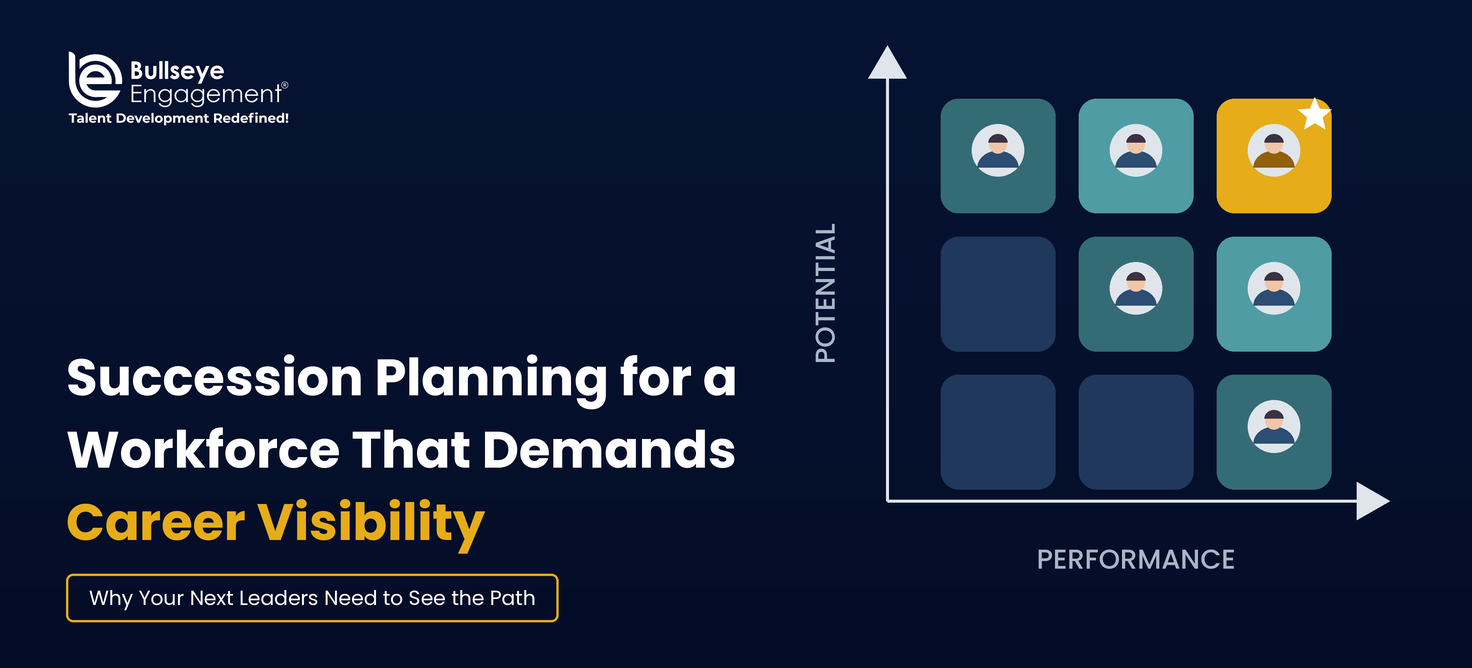
The 9-box talent matrix, plotting performance against potential, remains the standard visualization for a reason: it forces a leadership team to look at the whole population at once and argue about placements with evidence. Used badly, it becomes a caste system where a single meeting fixes someone’s box for years. The discipline that keeps it honest: performance placement comes from documented review history, potential placement requires stated evidence against the competency model, and every placement gets revisited on a cycle, because people move. An interactive matrix tied to live data beats a static slide precisely because it makes revisiting cheap.
Step 5: turn every gap into a development plan with a pulse
A succession plan without development plans is a wish list. Every identified successor should have an individual development plan that names their specific gaps against their target role, assigns concrete actions with dates, and gets reviewed in regular check-ins rather than annually. Connect the plan to your training management so completions update the record automatically, and to talent development programs so stretch assignments and mentoring aren’t improvised. The Harvard Business Review’s reskilling research is blunt on this point: development at the pace the market now demands has to run as a managed process, not an annual event.
Step 6: instrument the pipeline like an operation
What leadership sees monthly gets managed; what it sees annually gets performed. Put succession metrics on the standing leadership dashboard next to revenue and operations: pipeline coverage, readiness distribution, development plan momentum, and internal fill rate. When a critical role’s coverage drops because a successor resigns, leadership should see it that month, not at the next annual talent review. This is also where AI Advisor style analysis earns its keep: surfacing succession risks across the data continuously, so the annual review becomes confirmation rather than discovery.
Defining readiness so it means something
“Ready now” is the load-bearing phrase of every succession plan, and in most organizations it’s never been defined. Ask 5 leaders what it means and you’ll get 5 answers, which means your coverage ratio is measuring 5 different things. Before any of the metrics below can be trusted, readiness needs written definitions with evidence requirements. Here’s a working standard you can adapt.
Ready now means the person could assume the role within 90 days and perform at an acceptable level within 6 months, evidenced by: competency assessment at or above target level on the role’s critical competencies, sustained performance in the top bands for at least 2 cycles, demonstrated experience with the role’s hardest recurring situation (not classroom exposure, actual reps: the P&L conversation, the regulatory audit, the union negotiation, whatever the role’s crucible is), and confirmed aspiration, because readiness without willingness is a spreadsheet fantasy.
Ready in 1 to 2 years means the gaps are known, bounded, and closable on that clock, evidenced by: competency assessment within 1 level of target on critical competencies, a live development plan whose actions map to the specific gaps, and at least 1 stretch experience scheduled or in progress that rehearses the target role’s demands. The discipline here: every “1 to 2 years” designation must name what changes in that time. If nobody can say what the person will have done by then that they haven’t done now, the designation is a compliment, not a plan.
Ready in 3-plus years is a potential call, not a promise, evidenced by trajectory: competency growth across consecutive assessments, increasing scope handled well, and learning agility demonstrated in role changes. Keep this tier honest by capping it: a bench where 80% of names sit at 3-plus years is a recruiting pipeline wearing succession clothes.
Two enforcement rules make the definitions real. First, evidence or no designation: a readiness call without the backing assessment data doesn’t enter the system, which is easy to enforce when the succession platform requires the fields. Second, readiness decays: any designation untouched by fresh evidence for 12 months automatically flags for revalidation. People change, roles change, and a readiness call from 2 years ago describes 2 people who no longer exist.
Get the definitions right and everything downstream sharpens: coverage ratios become comparable across divisions, readiness velocity becomes measurable, and the talent review argues about evidence instead of vocabulary.
The 2-track model: emergency cover and deep bench
One more structural distinction separates programs that survive contact with reality from ones that don’t: succession runs on 2 tracks with different clocks, and collapsing them into 1 plan breaks both.
Track 1 is emergency cover. For every critical role: who takes the keys tomorrow morning if the incumbent resigns, falls ill, or gets recruited over a weekend? The interim designate doesn’t need to be the long-term successor, and often shouldn’t be; they need to be able to keep the function running for 90 to 180 days without damage. Emergency cover is cheap to build and criminally neglected: it’s a named person per role, a current documentation standard so the role’s knowledge doesn’t live in 1 head, and a brief the designate has actually read. The test of Track 1 is simple and worth running annually: pick a critical role, ask the interim designate 3 operational questions, and see what happens. Organizations that run this drill fix their documentation within the month.
Track 2 is the deep bench, everything the rest of this guide describes: multi-year development of genuine successors toward full readiness. Track 2 is where the strategic value lives, and it only works because Track 1 exists: a leadership team with credible emergency cover can let Track 2 candidates develop on honest timelines instead of panic-promoting the nearest warm body when a vacancy hits. Panic promotion is how organizations burn their best emerging talent, handing someone a role 2 years early, watching them struggle without support, and concluding they “weren’t ready” when the truth is the plan wasn’t.
The 2 tracks also answer different audiences. Boards and regulators mostly want proof of Track 1: continuity risk, managed. Employees and the retention math mostly care about Track 2: growth, visible. Run them as 2 named workstreams with 2 sets of metrics, and stop letting an emergency org chart masquerade as a development pipeline or vice versa.
The talent card: 1 source of truth per person
Everything in the architecture above produces data about people, and where that data lives determines whether the system works or decays. The failure pattern is familiar: competency assessments in 1 tool, 9-box placements in a slide deck, development plans in shared documents, performance history in the HRIS, and risk notes in a talent lead’s head. Six months later, no 2 sources agree, and every talent review starts with 45 minutes of reconciliation before anyone can discuss an actual human.
The fix is a unified profile per person, what Bullseye calls the Talent Card: competency levels, talent matrix placement, leadership assessment insights, risk indicators, development plan status, succession candidacies, and gap analysis, in 1 view that updates as the underlying data does. This sounds like a convenience feature. It’s actually the thing that changes the quality of talent conversations, for 3 reasons.
First, it collapses preparation cost. When a leadership team can open a current, complete profile in the meeting, talent reviews spend their time on judgment instead of archaeology. Reviews that are cheap to run happen more often, and frequency is what keeps succession data alive.
Second, it forces consistency. When the 9-box placement sits next to the performance history and the competency scores it’s supposed to reflect, contradictions become visible. A “high potential” placement beside 2 years of middling reviews and no competency growth invites the question it should invite. Scattered data lets those contradictions hide; unified data makes someone explain them.
Third, it’s the mechanism behind the individual-visibility layer from earlier. The same profile that powers the leadership conversation, minus the confidential succession elements, is what the employee sees: their competencies, their gaps against roles they’re targeting, their development plan and its progress. One data spine serving both audiences, rather than an official record and a sanitized brochure that drift apart.
If you take 1 architectural principle from this guide, take this: succession planning quality is downstream of data unification. Every succession failure mode in the next section gets easier to catch when the record is whole, and nearly impossible to catch when it’s scattered.
5 failure modes and how to catch them early
Succession programs rarely fail loudly. They fail quietly, over 2 or 3 years, and the postmortem always finds 1 of 5 patterns. Here they are, with the early symptom that lets you intervene before the decay compounds.
The annual resurrection. The program exists for 3 weeks a year: a data-gathering scramble before the talent review, an intense meeting, a deck, then silence for 11 months. Early symptom: development plan momentum, the percentage of successor IDPs touched in the last quarter, sits below 30%. The fix is structural, not motivational: put succession metrics on the monthly leadership dashboard, automate the reminders and check-in workflows, and make the annual review a summary of a living process instead of the process itself.
The mirror pipeline. Candidate slates that look exactly like the current leadership team, produced by sourcing through line-of-sight and sponsorship. Early symptom: your bench diversity metric diverges from your eligible population, or structured matching keeps surfacing names the room hasn’t considered and the names keep not making the slate. The fix: require that every slate include the top structured-match candidates alongside the sponsored ones, and require stated evidence when a matched candidate is passed over. Not to force outcomes, but to force reasons.
The paper bench. Coverage ratios look healthy because names fill the boxes, but the names aren’t real: successors who haven’t been assessed in 2 years, who’ve quietly disengaged, or who would decline the role if offered. Early symptom: a “ready now” successor turns down or fails the first actual transition. The fix is a readiness audit rhythm: every successor designation older than 12 months gets revalidated against current assessment data, and aspiration gets confirmed with the person, not assumed about them.
The development mirage. Successors are identified, gaps are documented, and nothing else happens: the development plans are lists of courses nobody scheduled and stretch assignments nobody staffed. Early symptom: readiness velocity flatlines; nobody moves up a readiness level year over year. The fix is making every gap resolve to a resourced action with an owner and a date, and treating an unstaffed development plan as a leadership delivery failure, the same way an unstaffed project would be.
The visibility whiplash. An organization publicizes its shiny new career framework, employees engage, build profiles, set targets, and then watch critical roles go to external hires with no explanation. This is the most damaging failure because it converts hope into cynicism, which is harder to reverse than indifference. Early symptom: internal fill rate stays flat after the visibility launch, or engagement survey scores on career questions rise and then fall. The fix: the written-explanation rule for every external hire into a covered role, reviewed quarterly, because the discipline of explaining exceptions is what keeps them exceptional.
Every 1 of these failure modes is visible in the 6 metrics from the previous section a year before it becomes a crisis. That’s the real argument for instrumentation: not reporting for its own sake, but an early-warning system for the specific ways this discipline dies.
How to run the talent review meeting itself
All the architecture above converges on 1 room: the talent review. Get that meeting right and the system works. Get it wrong and you’ve built expensive infrastructure for a gossip session. Here’s the format that keeps it honest, refined across a lot of organizations that learned each rule the hard way.
Before anyone walks in: placements are drafted in the system, not in the meeting. Each manager enters proposed 9-box positions and readiness calls ahead of time, with the evidence attached. The meeting exists to challenge and calibrate drafts, not to generate opinions live. This 1 change cuts meeting time roughly in half and, more importantly, gives quieter voices the same weight as confident ones, because everyone’s input arrives in writing before the loudest person in the room starts talking.
The evidence rule, enforced without mercy: every claim about a person gets the same challenge: “what did you observe?” Not “what’s your sense of them”, not “how do they come across”. Observed behavior, documented outcomes, assessment results. When someone says “I just don’t see her as a leader”, the chair’s job is to ask what specifically was observed, and if the answer is nothing, the comment doesn’t touch the placement. You’ll be amazed how much conventional wisdom about people evaporates under that 1 question. That’s the point.
Time-box per person, and cover everyone: the classic failure is spending 40 minutes debating 2 controversial placements and waving through 30 others. Cap discussion at 5 minutes per person; anything unresolved gets a named owner and a follow-up, not more meeting. And review the whole population in scope, because the people nobody argues about are where both your hidden gems and your quiet flight risks live.
Decisions leave the room in the system: every placement change, development commitment, and follow-up lands back in the platform before the meeting ends, with owners and dates. A talent review that produces a beautiful discussion and no recorded commitments is a book club. The Talent Card view makes this cheap: updates happen against the live record, so next quarter’s meeting starts from reality instead of from reconstructing what was said.
And 1 rule for the chair: track who gets described in potential language versus performance language across the whole session. If some groups keep getting “solid, reliable, great execution” while others get “high ceiling, ready for more”, you’re watching bias operate in real time, and naming the pattern in the room is the most effective calibration tool that exists.
The metrics that tell you it’s working
Six numbers, tracked quarterly, give you the health of the system:
- Coverage ratio: percentage of critical positions with at least 1 successor at “ready now” or “ready in 1 to 2 years”. Industry practice aims for 2 or more candidates per role; your first honest measurement will likely be uncomfortable, which is the point.
- Readiness velocity: average time for successors to advance a readiness level. If nobody ever moves from “ready in 3 years” to “ready now”, you have a development problem wearing a succession costume.
- Development plan momentum: percentage of successor IDPs updated in the last quarter. Stale plans predict stalled pipelines about as reliably as anything in HR.
- Internal fill rate for critical roles: the outcome metric. It should climb as the system matures, and every external hire into a covered role deserves a written explanation of why the pipeline didn’t produce.
- Successor retention: turnover rate among identified successors versus comparable peers. If your successors leave at the same rate as everyone else, your plan is invisible to the very people it’s about, which defeats the purpose.
- Bench diversity: demographic composition of successor pools versus the eligible population. Sourcing through line-of-sight quietly narrows this; structured matching should measurably widen it, and this metric proves whether it has.
How much to tell people: the disclosure question
Every succession redesign eventually hits the hard question: do we tell employees they’re identified successors? Here’s the framework we recommend, as 3 concentric circles of disclosure.
Tell everyone: the system. Publish how succession works: what critical roles are, how readiness is defined, how candidates are sourced, what development support exists. This costs nothing, builds trust, and lets ambitious people opt into the work of becoming candidates.
Tell individuals: their own data. Every employee sees their own competency profile, their own gaps against roles they’re interested in, and their own development plan. This is the career visibility layer, and it applies to your whole workforce, not just anointed successors. The succession pipeline becomes the natural output of a system everyone can engage with.
Keep confidential: the slates. Specific candidate lists for specific roles stay restricted. Naming successors publicly creates entitlement for those named, disengagement for those not, and legal exposure when plans change. The exception: it’s often right to tell a “ready now” successor for a near-term transition that they’re being prepared, paired with the honest caveat that preparation isn’t promise.
This structure gets you the retention value of visibility without the wreckage of published lists. Employees who can see the system and their own position in it don’t need to see the slate to believe a future exists for them.
Keeping the bench you built: successor retention economics
There’s a cruel irony built into succession planning: the act of identifying your highest-potential people also identifies the people every competitor and recruiter wants most. A succession program that develops people without a deliberate retention strategy for them is, functionally, a finishing school for other companies’ leadership teams.
The retention plan for successors runs on 3 tracks. The first is the visibility work this whole guide describes: a successor who can see their development progressing, their gaps closing, and internal roles filling internally has a concrete answer to every recruiter’s opening message. The second is investment signaling: stretch assignments, executive exposure, and mentoring aren’t just development mechanics, they’re legible evidence that the organization is spending real resources on this person’s future, and people are reluctant to walk away from visible investment in themselves.
The third track is money, and it deserves more precision than it usually gets. Compensation for successors shouldn’t wait for the promotion; by the time the role opens, an underpaid “ready now” successor has been recruitable at a premium for 2 years. Connect your succession data to compensation planning so that readiness advancement triggers a comp review, and so retention-critical successors in your highest-risk roles get ahead-of-market adjustments while they wait. The math is straightforward: the premium to retain a developed internal successor is a fraction of the cost of an external executive search plus ramp time plus the failure rate of outside leadership hires.
Track it with the successor retention metric from above, and read exits carefully. When a successor leaves, the exit interview question that matters is whether they could see the path. If the answer is no, the loss wasn’t a compensation failure or a recruiter’s win. It was a visibility failure, and it’s the one variety you fully control.
Succession in regulated and high-stakes industries
If you operate in banking, healthcare, utilities, or public sector environments, succession planning is increasingly an examined item, not an internal nicety. Regulators and accreditors want evidence that continuity risk for critical functions is identified and managed. “We have a plan” satisfies nobody; “here’s our coverage ratio, our named readiness criteria, and our development audit trail” ends the conversation.
The requirements that keep organizations compliant happen to be the same ones that make succession genuinely work: documented criteria, evidence-based assessments, tracked development, and reviewable history. Centralizing this in succession planning software rather than spreadsheets and email threads isn’t about convenience. It’s about being able to produce the record when the examiner, the board, or the plaintiff’s attorney asks for it, and about reminders and workflows that keep the process alive between reviews instead of reconstructing it before them.
Healthcare deserves a special note: clinical leadership succession carries credentialing requirements on top of competency ones, and workforce shortages make external replacement slower and costlier than almost any other industry. The organizations handling it well run succession and workforce planning as 1 connected exercise, so pipeline decisions reflect projected demand, not just current vacancies.
The first 90 days of a visible succession program
Days 1 to 30: score and rank your critical positions. Draft competency models for the top 10. Baseline your current coverage honestly, including the roles where the honest answer is zero.
Days 31 to 60: run structured candidate matching against the full population for those 10 roles. Hold your first evidence-rule 9-box session. Note where the matched slate differs from the instinctive one; that difference is your sourcing bias, measured.
Days 61 to 90: stand up development plans for every identified successor. Publish the system-level disclosure to all employees: how succession works here, and how anyone can see their own profile and gaps. Put the 6 metrics on the leadership dashboard and set the quarterly review rhythm.
Then let the compounding start. Succession programs don’t deliver in a quarter; they deliver when the third cycle of development plans matures just as the second unexpected vacancy hits, and the role fills in 2 weeks from a bench you built on purpose.
Frequently asked questions
Won’t showing employees role requirements and their gaps just help them shop externally? They’re already shopping; the external market is fully visible to them today. What they can’t currently see is the internal path. Adding internal visibility doesn’t arm departures, it creates the comparison that keeps people: a known path here versus a cold start elsewhere. The risk runs the other way.
How many successors should each critical role have? Target at least 2, ideally at staggered readiness. A single successor is a single point of failure, and the moment they know they’re the only name, the negotiating power flips to their side of the table. Depth is what makes the plan a plan rather than a hope.
What if a critical role genuinely has no internal candidates? Then you’ve learned something valuable 18 months before the vacancy would have taught it to you brutally. That role gets a deliberate response: targeted external hiring into feeder positions, an accelerated development investment in the nearest internal profiles, or role redesign to reduce the concentration of hard-to-replace skills.
How does succession planning differ from replacement planning? Replacement planning names who takes over tomorrow if someone gets hit by a bus: it’s continuity insurance. Succession planning develops people toward readiness over time: it’s a talent supply chain. You need both, and confusing them is why so many “succession plans” are just emergency org charts with no development underneath.
Who should own succession planning: HR or the business? Split it cleanly and write the split down. HR owns the system: the framework, the data quality, the meeting cadence, the metrics, and the enforcement of the evidence rule. Line leadership owns the outcomes: the placements, the development commitments, and the pipeline health of their own critical roles, reported upward like any other operational number. Programs die when this inverts, when HR chases executives for inputs to a process the executives treat as HR’s homework. The tell of a healthy program is a business leader who can quote their own coverage ratio without looking it up.
What happens when 2 strong successors are ready for the same role? Congratulations, you’ve hit the good problem, and how you handle it echoes through your whole talent population. Three moves: be honest with both about the situation rather than letting them discover it, actively develop the runner-up toward adjacent roles so their path doesn’t dead-end on 1 door, and treat the depth as the asset it is, because roles have a way of multiplying during reorganizations and the “loser” of this round is your instant answer to the next vacancy. What you must not do is let the ambiguity sit silent while both quietly interview elsewhere. Two ready successors leaving over 1 role is the most preventable double-loss in talent management.
How do we keep succession data from going stale between reviews? Wire it to events instead of calendars. A resignation in a critical role’s chain, a completed development milestone, a competency assessment update, a performance review cycle closing: each should touch the succession record automatically or trigger a human to. This is honestly the strongest argument for running succession in connected software rather than an annual spreadsheet: the data stays alive because the systems feeding it never stop. If your succession data can only be trusted in the month after the talent review, you don’t have a pipeline, you have an annual photograph of one.
Should managers know when their direct reports are successors for roles elsewhere in the organization? Yes, and this is a culture test disguised as a process question. Managers who hide or hoard talent are the single biggest internal-mobility blocker, and secrecy makes hoarding free. When succession candidacies are visible to leadership and managers are measured partly on talent exported to the rest of the organization, the incentive flips: developing someone toward a bigger role elsewhere becomes a visible managerial win rather than a quiet loss. If your culture would punish that transparency, fix that before scaling the program, because a succession pipeline running through hoarding managers leaks at every joint.
Can smaller organizations without dedicated talent teams run this? The architecture scales down cleanly; only the ceremony needs cutting. A 300-person company might have 8 critical roles, not 40, and the leadership team is the talent review committee. What doesn’t scale down is the discipline: competency-defined readiness, evidence-based placement, live development plans, and quarterly metrics matter more in a small organization, not less, because each critical vacancy is a larger share of total capability. Software carries proportionally more of the load when there’s no talent team to run manual processes, which is the honest argument for tooling at that size.
How often should the 9-box and readiness ratings be revisited? Twice a year as a floor, quarterly where you can, and immediately upon trigger events: a successor resignation, a critical role change, a major reorganization. The fastest way to kill the program’s credibility is a matrix that still shows someone who left 6 months ago.
The bottom line
The workforce didn’t stop caring about advancement. It stopped waiting for organizations that hide it. Succession planning built for this era runs on evidence instead of reputation, shows every employee the system and their own position in it, keeps candidate slates confidential, and puts pipeline health in front of leadership monthly.
Do that, and succession stops being the locked drawer HR opens once a year. It becomes the reason your best people can picture their next 5 years without opening a job board.
If you want to see an evidence-based, visible succession pipeline running on live data, from critical role identification through Talent Match, the interactive 9-box, and development tracking, book a demo with the Bullseye team. We’ll show you what your coverage ratio looks like when it’s real.Succession planning for a workforce that demands career visibility