Here’s a question worth asking your leadership team this week: how many of last cycle’s performance reviews were written by AI? Not “does our policy allow it”. How many actually were?
If your honest answer is “no idea”, you’re in good company, and that’s the problem. Managers everywhere are pasting bullet points into chatbots and getting back polished paragraphs. Some of those paragraphs are good. Many are generic. A few describe accomplishments that never happened.
This isn’t a future problem. It’s a today problem, and most organizations have no policy for it. Managers are making up the rules as they go, which means your review process now has an invisible, unaccountable participant whose output nobody is checking.
The instinct in many HR teams is to ban AI from reviews entirely. Understandable. Also hopeless. The tools are on every manager’s phone, and prohibition just pushes the usage underground where you can’t see it. The realistic question isn’t whether AI touches your performance process. It’s what role you assign it.
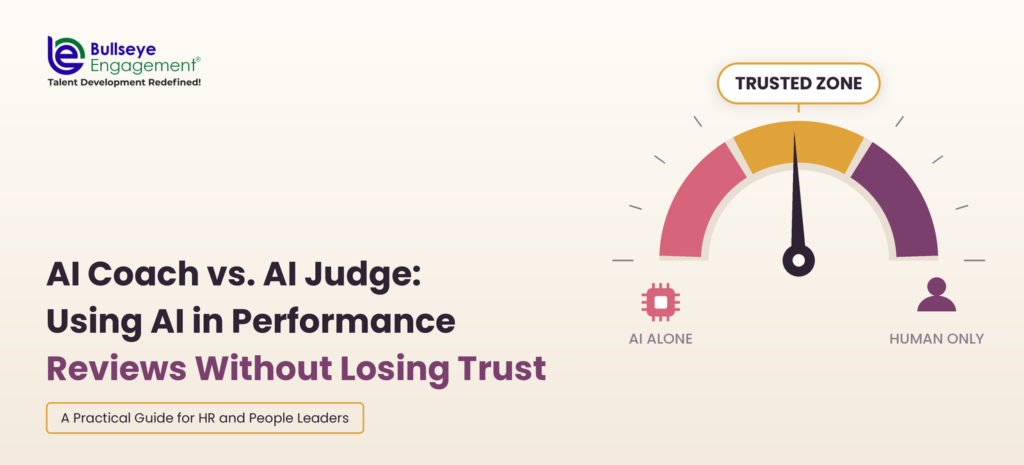
There are 2 roles on offer. AI can act as a judge: scoring people, drafting verdicts, and deciding what a year of work was worth. Or AI can act as a coach: helping managers prepare, communicate, and follow through, while humans keep every decision. That distinction sounds subtle. In practice, it’s the difference between a performance process your people trust and one they quietly resent.
This guide breaks down both roles, shows you what each looks like in a real review, gives you a 3-tier governance framework you can adopt this quarter, and includes a policy skeleton you can hand to managers on Monday.
Why AI landed in performance reviews so fast
Performance reviews have been broken for a long time, and everyone involved knows it. Gallup’s research on performance management found that only 14% of employees strongly agree their performance reviews inspire them to improve. Think about that number. The single most formal feedback mechanism in most companies leaves 86% of people uninspired at best.
Managers feel the pain from the other side. Writing 8 or 10 thoughtful reviews on top of a full workload is genuinely hard. The blank page is intimidating, the rating conversation is awkward, and HR’s deadline doesn’t move. So when a tool appeared that could turn 4 bullet points into 4 paragraphs in 10 seconds, adoption didn’t wait for permission.
None of this makes managers villains. It makes them rational actors inside a process that asks too much and supports too little. The problem isn’t that managers reached for help. The problem is what kind of help they reached for, and what happens to trust when employees figure it out.
And they do figure it out. AI-drafted reviews have a texture: confident, smooth, and oddly weightless. They praise “strong communication skills” and “valuable contributions to the team” without a single specific moment attached. Employees read that and draw the obvious conclusion: my manager didn’t think about me for even 10 minutes this year. Whatever engagement the review was supposed to build, that realization destroys it.
The AI judge: what it is and why it fails
The AI judge is any use of AI that produces or heavily shapes an evaluative outcome. That includes:
- Generating review narratives from thin inputs and submitting them with light edits
- Suggesting or assigning performance ratings
- Summarizing a year of work from activity data and treating the summary as the assessment
- Screening or ranking employees for calibration, promotion, or reduction decisions
Each of these fails for a specific, predictable reason. Let’s take them in turn.
Failure 1: the evidence problem
A review is supposed to be a claim backed by evidence. The manager observed things across a year, and the review documents them. When AI generates the narrative, the causal chain reverses: the text exists first, and the evidence is assumed. Large language models are built to produce plausible text, and plausible is exactly the problem. An AI-drafted review will happily state that an employee “consistently exceeded targets” whether or not anyone checked a target.
When an employee challenges a review, and eventually one will, “the tool wrote it” is not a defense. It’s an admission.
Failure 2: the bias amplifier
There’s a comforting story that AI removes human bias from evaluations. The evidence points the other way. Models trained on historical text reproduce the patterns in that text, including the well-documented tendencies in performance feedback: women receive more personality-focused and less actionable feedback, while men receive more feedback tied to business outcomes. Feed a model 2 similar sets of bullet points with different names attached and you can get systematically different tones back.
Human bias in reviews is bad. Human bias laundered through a tool that gives it a neutral, authoritative voice is worse, because it’s harder to see and easier to defend. The NIST AI Risk Management Framework exists precisely because automated systems can produce harms that are “silent” in exactly this way: no single output looks wrong, but the pattern across hundreds of outputs is discriminatory.
Failure 3: the legal exposure
Performance documentation is legal documentation. It’s what your organization stands on when a termination, promotion decision, or pay outcome is challenged. Documentation generated by a tool, containing claims the manager can’t personally verify, describing events the manager may not remember, is a gift to opposing counsel. If your reviews feed compensation and separation decisions, and they should, then AI-fabricated content in those reviews isn’t a quality issue. It’s a liability.
Failure 4: the trust collapse
This is the failure that costs the most and shows up last. Performance conversations work because the employee believes their manager actually watched, actually thought, and actually cares about the answer. That belief is the asset. Every generic AI paragraph spends it down. Once an employee concludes the review is machine-generated, they stop treating feedback as information and start treating it as paperwork. You don’t get that back with a better prompt.
The AI coach: the role AI should play
Now flip the frame. Instead of asking AI to produce judgments, ask it to make the humans in the process better at their jobs. That’s the coaching posture, and it changes everything about where AI sits in the workflow.
An AI coach operates before and around the human conversation, not in place of it:
It helps managers prepare. Before a difficult conversation, a manager can rehearse: here’s the situation, here’s what I want to say, how will this land? A well-built coaching layer knows something about the individual on the other side of the table, their working style, what motivates them, how they process criticism, and helps the manager shape the message so it actually gets heard. This is the design behind Bullseye’s AI Coach, which grounds its conversation guidance in personality and motivation insight rather than generic communication tips.
It prompts in the moment, not just at cycle time. The worst performance conversations are the ones that never happened in March and became grenades in December. Coaching-oriented AI nudges managers toward timely feedback: a check-in that’s overdue, a goal that’s drifting, friction on a team that’s building toward escalation. Early friction detection with a practical resolution path is worth more than the most eloquent year-end narrative.
It checks the manager’s work without replacing it. Here’s where drafting help is legitimate. A manager writes their own assessment, with their own observations, and then asks: is this specific enough? Is the language about this person’s style rather than their results? Am I describing behavior or assigning motives? Bias-aware prompting that reviews human-written content is the honest version of AI in reviews. The manager stays the author; the AI is the editor who asks hard questions.
It builds new managers faster. First-time managers are the weakest link in most review cycles, not because they don’t care but because nobody taught them how to deliver hard feedback. A coaching layer that walks them through expectation-setting and performance conversations compresses years of trial-and-error into months. That’s a workforce capability, not a shortcut.
The line between judge and coach is simple to state: the AI coach improves the quality of human judgment; the AI judge substitutes for it. Every proposed AI use in your performance process can be sorted with that one test.
Side by side: the same review, 2 ways
Abstractions only go so far. Here’s what the difference looks like on the page.
The AI-judge version. A manager types “Priya – project delivery, stakeholder comms, mentoring” into a chatbot and pastes the result:
“Priya has been a valuable member of the team this year. She consistently demonstrates strong project delivery skills and communicates effectively with stakeholders at all levels. Her mentoring of junior colleagues reflects her commitment to team success. Priya should continue to build on these strengths in the coming year.”
Nothing in that paragraph is false. Nothing in it is true either. It contains no event, no number, no decision, no moment. Priya can’t learn from it, and a compensation committee can’t act on it. It’s word-shaped filler.
The AI-coached version. The same manager writes their own draft from notes, then runs it through a coaching pass that flags 2 things: the feedback names outcomes but no behaviors, and the development section is vague. The manager revises:
“Priya delivered the vendor migration 3 weeks early by renegotiating the cutover sequence when the client froze their environment in June. That decision saved the Q3 timeline. Her weekly stakeholder notes became the model the rest of the team now uses. Two of her mentees passed certification this year, and both named her coaching in their feedback. For next year: Priya avoids escalating even when escalation is right. The October scope dispute cost us 2 weeks that a direct conversation in week 1 would have saved. Her development goal is to raise conflicts within 5 working days, and we’ll review it monthly.”
Same manager, same employee, same 10 minutes of AI involvement. One version replaced the manager’s thinking. The other sharpened it. Employees can tell the difference in a single read, and so can an employment lawyer.
Where the coaching data comes from matters as much as the coaching
Two AI coaching products can look identical in a demo and be opposites underneath, because the guidance is only as trustworthy as the data it’s grounded in. There are 3 grounding models on the market, and you should know which one you’re buying.
Model 1: no grounding at all. The tool is a general-purpose language model with a coaching prompt bolted on. Ask it how to give Priya feedback and it gives you advice for a statistical average of all employees ever written about on the internet. The advice isn’t wrong, exactly. It’s horoscope-grade: broad enough to apply to anyone, which means it’s calibrated to no one. Managers figure this out in about 2 weeks and stop opening the tool.
Model 2: grounding in surveilled behavior. The tool mines the employee’s emails, chat messages, calendar patterns, and meeting participation to build a behavioral profile, then coaches the manager based on it. This model has real signal and a fatal cost: it converts every workplace interaction into assessment data without consent, and the first time employees learn that their message tone fed a profile their manager gets coached from, you’ve traded a feature for your culture. There’s also a validity problem: communication metadata measures how someone writes under workload, not who they are. Quiet people get profiled as disengaged. Blunt people get profiled as difficult. The model inherits every bias of judging people by their busiest Tuesday.
Model 3: grounding in validated psychometrics. The employee completes a proper psychometric instrument, voluntarily and transparently, and the resulting profile of working style, motivators, and communication preferences powers the coaching. This is the model behind Bullseye’s AI Coach, which pairs AI with Humantelligence’s psychometric science. The difference in practice: the manager preparing to deliver hard feedback gets guidance shaped to how this specific person processes criticism, whether they need context before conclusions or conclusions before context, whether they respond to challenge or to reassurance. And the employee knows exactly what data exists about them, because they generated it on purpose.
The question to ask any vendor is simple: “What does the coaching know about my employee, and how did it learn it?” If the answer involves scraping communications, you’ve found a judge wearing a coach’s jacket. If the answer is “nothing specific”, you’ve found a very expensive fortune cookie. The defensible answer is declared, validated, consented data.
Rolling out the framework: a 6-week sequence
Governance frameworks fail through big-bang launches: a policy PDF lands in every inbox, nobody reads it, and 6 months later the behavior hasn’t changed. Here’s a sequence that has the policy arriving after the understanding instead of instead of it.
Weeks 1 and 2: find the actual baseline. Survey managers anonymously: are you using AI for review prep, drafting, or editing today, and which tools? Anonymity matters because you’re measuring reality, not compliance theater. Expect the number to be at least double your guess. While that runs, pull a sample of last cycle’s reviews and score them for specificity. This gives you a before picture and, usually, the internal evidence that generic reviews were already a problem before AI accelerated them.
Weeks 3 and 4: draft with managers, not at them. Take the 3-tier framework and the policy skeleton to a working group of 8 to 10 managers, including at least 2 who admitted heavy AI use. Let them argue about where specific uses land. The arguments are the training: a manager who spent 20 minutes debating whether AI-structured self-assessments are Tier 1 or Tier 2 understands the framework in a way no memo will achieve. You’ll also catch edge cases the HR team didn’t imagine.
Week 5: ship the policy with the alternative in the same breath. The single most common rollout error is announcing restrictions before providing the sanctioned path. If the policy prohibits consumer chatbots but the approved coaching tool arrives next quarter, you’ve guaranteed 1 quarter of hidden usage. Launch the policy and the approved tooling together, with the explicit message: here’s the line, and here’s the better option on the right side of it.
Week 6 and onward: instrument and iterate. Start the measurement program from the section above, and set a 90-day review of the policy itself. The AI landscape moves fast enough that a policy without a revision rhythm is a snapshot, not a control. The 90-day review also signals to managers that the framework is a living agreement, which keeps the reporting channel open when new tools appear.
Total elapsed time: 6 weeks. Total new bureaucracy: 1 page and 1 quarterly review. This is deliberately light, because a governance process heavier than the risk it manages gets routed around, and routed-around governance is worse than none: it teaches people that the rules are decoration.
Prompts your managers can actually use (and 2 they shouldn’t)
Policies tell managers what not to do. If you want the coach model to stick, show them what good usage looks like. Here are 5 prompt patterns worth putting in your manager guide, all safely inside Tiers 1 and 2, followed by the 2 patterns that cause most of the damage.
The rehearsal prompt. “I need to tell a strong performer that they’re not getting the promotion this cycle. Here’s what I plan to say: [draft]. What questions will they probably ask, and where might this land badly?” The AI plays the other side of the table. The manager walks in prepared instead of improvising the hardest conversation of the quarter.
The specificity check. “Here’s a review paragraph I wrote: [paragraph]. Point out every claim that isn’t backed by a specific example, and every place I describe personality instead of behavior.” This is AI as the editor who asks hard questions. The manager wrote the content; the AI stress-tests it.
The bias sweep. “Compare these 2 review drafts I wrote for 2 team members: [drafts]. Is my language noticeably different in tone, specificity, or focus between them?” Managers rarely see their own patterns. A side-by-side check catches the classic asymmetries, results language for one person, personality language for another, before the reviews go out.
The translation prompt. “I need to explain to a detail-oriented, risk-averse team member why we’re changing their project scope. Help me structure this so it leads with the reasoning, not the conclusion.” Guidance tuned to how the specific person processes information. This is exactly what a psychometrically grounded tool like AI Coach does natively, with real insight about the individual instead of the manager’s guess.
The follow-through prompt. “Here are my notes from today’s check-in with [no names, just ‘my team member’]: [notes]. Turn these into 3 clear commitments with suggested check-back dates.” Admin work AI is genuinely good at, applied to a conversation that already happened between humans.
Now the 2 patterns to name and shame in your training, because they account for most of the trouble:
The ghostwriter prompt. “Write a performance review for an employee who did well on projects and communicates effectively.” No inputs, no evidence, no author. Whatever comes back is fiction with good grammar, and the manager who submits it has signed their name to fiction.
The verdict prompt. “Based on these notes, what rating should this employee get, 1 to 5?” The moment a model suggests a number, that number anchors the human, and the human’s judgment quietly becomes an edit to the machine’s. Ratings are Tier 3 for a reason. Don’t let them in through a side door.
Put these 7 patterns on 1 page, and you’ve done more for responsible AI adoption than most 40-page policies manage.
The regulatory map: what’s already law, not what’s coming
If the trust argument doesn’t move your executive team, the compliance argument will, because AI in employment decisions is one of the most actively regulated corners of the entire AI landscape. Three regimes matter for performance management right now, and the pattern across all of them supports the coach-not-judge line almost exactly.
The EU AI Act classifies AI systems used in employment, including those making or influencing decisions about promotion, termination, task allocation, and performance evaluation, as high-risk. That classification triggers real obligations: risk management systems, human oversight requirements, data governance, logging, and transparency to the people affected. If you operate in Europe or employ people there, an AI tool that rates or ranks your employees isn’t a productivity purchase, it’s a regulated system with documentation duties attached. The European Commission’s regulatory framework overview is the primary source worth bookmarking. Notice what stays out of high-risk territory: tools that coach a human who makes the decision. The regulation is drawing the same line this article does.
New York City’s Local Law 144 requires annual independent bias audits for automated employment decision tools used in hiring and promotion, published results included. The definition turns on whether the tool substantially assists or replaces discretionary decisions, which is regulatory language for the judge role. A coaching layer that helps a manager prepare for a conversation doesn’t trip the definition; a system that scores candidates for promotion does, audit and all. The city’s official AEDT page has the requirements. Other US jurisdictions are following the template, with Illinois and Colorado already legislating in adjacent territory, so treat NYC as the preview, not the exception.
The general employment law you already have. Even with zero AI-specific statutes, every discrimination framework on the books applies to AI-influenced decisions exactly as it applies to human ones. An adverse impact produced by an algorithm is still an adverse impact, and “the vendor’s model did it” has no legal meaning. This is the quiet reason Tier 3 exists: decisions you might have to defend need a human who made them, understood them, and can testify to the reasoning.
The strategic takeaway isn’t fear, it’s convergence. Regulators worldwide are independently arriving at the distinction this article started with: AI that assists human judgment gets light treatment, AI that substitutes for it gets heavy treatment. Building your governance on the coach-judge line today means the next wave of regulation lands on an organization that’s already compliant, while your competitors retrofit under deadline.
The maturity path: crawl, walk, run
Not every organization should implement everything above at once, and pretending otherwise is how programs stall. Here’s the honest sequencing, in 3 stages, with the exit criteria that tell you you’re ready for the next one.
Crawl: get legal and get visible. Approved tooling with enterprise data terms, the 1-page policy, the manager prompt guide, and the anonymous usage baseline. That’s it. You’re not transforming anything yet; you’re replacing hidden, ungoverned usage with visible, governed usage. Exit criteria: a majority of managers can state the Tier 3 list from memory, and your review specificity sampling has a baseline number. Most organizations can crawl in a quarter, and skipping this stage to buy sophisticated tooling first is the most common sequencing error in the market.
Walk: coach the moments that matter. Introduce real coaching support for the highest-stakes conversations: feedback delivery, goal misses, development discussions. This is where psychometrically grounded coaching enters, because generic advice dies at this stage. Wire the measurement program: conversation frequency, specificity trend, and the trust survey item. Exit criteria: check-in cadence holds for 2 consecutive quarters without HR chasing, and specificity scores are visibly rising. Expect 2 to 3 quarters here, longer in organizations with heavy manager turnover.
Run: close the loop at the leadership level. Now the coaching data, performance signals, and talent processes connect: AI Advisor style analysis surfacing risks across the population, friction detection feeding early intervention, and performance quality metrics sitting on the standing executive dashboard next to financials. This stage is where the program stops being an HR initiative and becomes how the organization manages. Exit criteria don’t exist, because run is a steady state: the 90-day policy reviews, the quarterly metric reads, and the annual revalidation of the tier assignments as tools evolve.
The stages also give you the answer to the budget question of when to buy what. Crawl needs almost no spend. Walk is where the per-manager tooling investment belongs, once governance exists for it to live inside. Run is where analytics investment pays, once there’s 2-plus quarters of behavioral data worth analyzing. Money spent 1 stage ahead of your maturity is the most reliably wasted money in HR tech.
The 3-tier governance framework
Policy beats prohibition. Here’s a framework you can adapt, structured as 3 tiers of AI involvement. It maps cleanly onto the govern-map-measure-manage logic of the NIST AI Risk Management Framework without requiring your managers to read a federal publication.
Tier 1: AI-encouraged
Uses where AI involvement is safe and actively helpful. No disclosure needed beyond your general policy.
- Rehearsing difficult conversations before having them
- Getting suggestions for phrasing feedback constructively, applied to the manager’s own observations
- Reminders and nudges for check-in cadence and goal updates
- Summarizing the manager’s own notes back to them for review prep
- Coaching for new managers on conversation structure
Tier 2: AI-assisted, human-authored
Uses where AI can participate but a human must originate and verify the content, and the organization should be able to audit that.
- Editing passes on manager-written review drafts (clarity, specificity, bias checks)
- Structuring a self-assessment the employee wrote
- Drafting development plan language from goals the manager and employee already agreed
The rule for Tier 2: every factual claim in the final document must trace to something the human author personally observed or verified. AI can shape sentences. It can’t supply facts.
Tier 3: human-only
Uses where AI output is prohibited, full stop.
- Assigning or recommending performance ratings
- Generating review narratives from scratch or from thin bullet points
- Making or ranking promotion, compensation, or termination decisions
- Producing the documentation for a performance improvement plan
- Analyzing an individual’s communications or activity data to infer performance
Tier 3 isn’t anti-AI. It’s pro-accountability. Decisions that change someone’s career need a human owner who can explain the reasoning in their own words, because someday they may have to.
A policy skeleton you can adapt
Most organizations don’t need a 20-page AI policy for reviews. They need 1 page that managers will actually read. Here’s a skeleton:
- Purpose. AI tools can improve how we prepare for and deliver performance feedback. They cannot replace manager judgment. This policy defines the line.
- Permitted uses. (Insert your Tier 1 and Tier 2 lists.)
- Prohibited uses. (Insert your Tier 3 list.)
- The verification rule. You are personally accountable for every word in a review you sign. If AI helped you edit, every factual claim must be something you observed or verified yourself.
- The specificity rule. Reviews must reference specific events, decisions, and outcomes. A review that could describe any employee describes no employee, and it will be returned.
- Data handling. Never paste employee names, compensation data, health information, or performance history into consumer AI tools. Use only the tools the organization provides, which are covered by our data agreements.
- Disclosure. If asked by an employee whether AI was used in their review, answer honestly. Under this policy, the honest answer should always be: “AI helped me edit and prepare; the observations and judgments are mine.”
- Support. If you’re using AI because you don’t have time to write reviews properly, tell HR. That’s a workload problem we want to fix, not a corner we want you to cut.
Point 8 matters more than it looks. Manager shortcuts are usually a symptom. If your review process demands 20 hours nobody has, the fix is process design, not policy enforcement.
What to measure once the policy is live
A governance framework without measurement is a memo. Track 4 things:
Feedback specificity. Sample reviews each cycle and score them: does each assessment cite concrete events and outcomes? Rising specificity means the coaching posture is working. You can operationalize this inside your performance management platform by making evidence fields required rather than optional.
Conversation frequency. The point of AI coaching is more and better human conversations, so count them. Check-in completion rates, time between feedback events, percentage of goals with a mid-cycle update. Gallup’s work on fast feedback ties meaningful weekly feedback to sharply higher engagement, which gives you an external benchmark for why cadence matters.
Escalation and friction trends. If your coaching layer detects friction early, downstream indicators should move: fewer formal grievances, fewer surprise resignations, fewer PIPs that arrive without any prior documented conversation. Roll these into your leadership dashboards next to your other human capital KPIs so executives see the trend, not anecdotes.
Employee trust in the process. Ask directly in your engagement survey: “My last performance conversation reflected a genuine understanding of my work.” That single item, tracked over time, tells you whether your AI posture is building trust or spending it.
How Bullseye draws the line
We built our AI capabilities around the coach-not-judge principle because we watched the judge model fail in the market before we wrote a line of code.
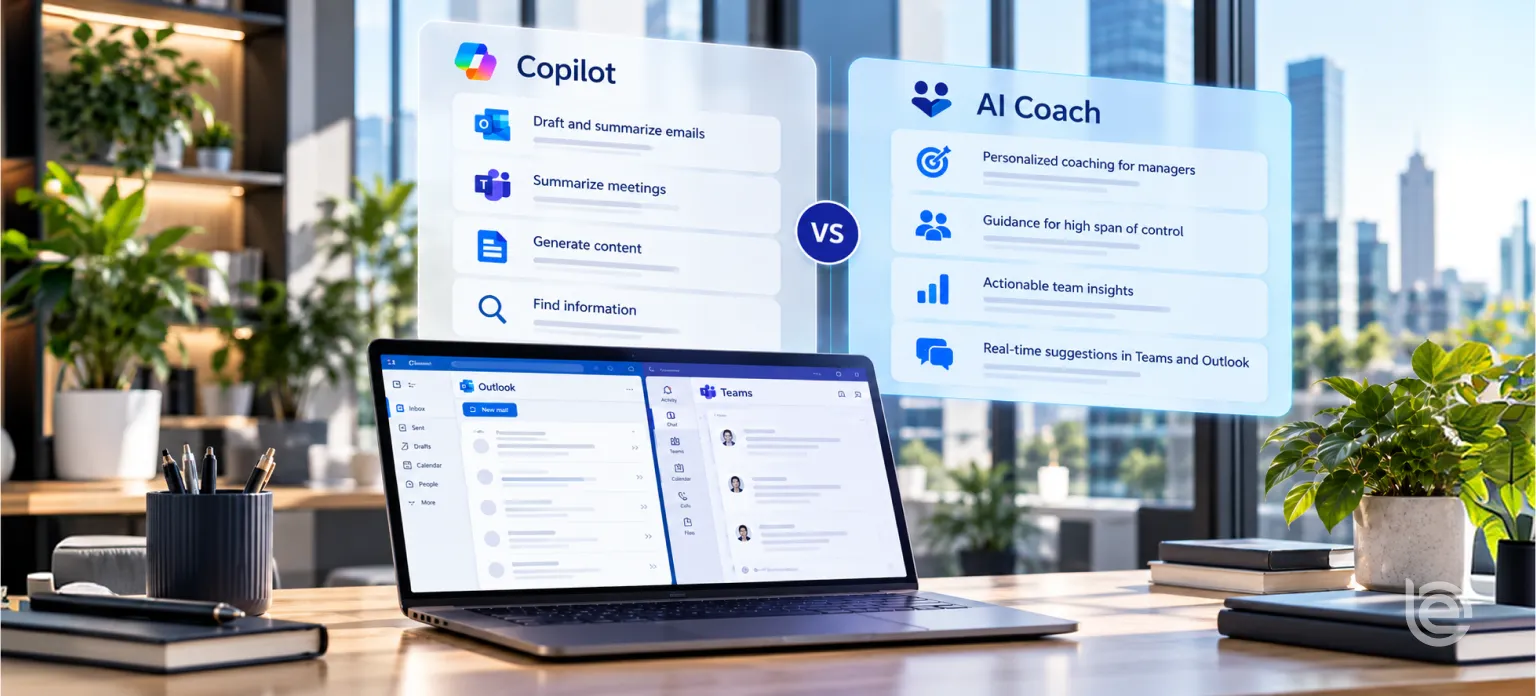
AI Coach gives managers real-time guidance for feedback, goal conversations, conflict, and development, grounded in psychometric insight about how each individual communicates and what motivates them. It works inside the tools managers already live in, including Teams and Outlook, and it’s designed to drive follow-through: the conversation happens, the commitment gets tracked, the habit builds. It never writes an evaluation and never assigns a score.
AI Advisor works the leadership side of the same principle. It analyzes signals across performance, succession, and engagement data to surface risks and produce leadership-ready guidance. It tells a VP that 3 critical roles have no ready successor. It doesn’t tell her whom to promote. The decision, and the accountability, stays human.
Both sit inside the Bullseye platform, where check-ins, goals, reviews, and recognition already live, so the coaching happens in the flow of real performance work rather than in a separate tool nobody opens.
Frequently asked questions
Should we tell employees that managers can use AI in the review process? Yes. Secrecy is the judge model’s habit. A 2-sentence disclosure, “managers may use approved AI tools to prepare for and edit performance conversations; all evaluations and ratings are made by humans”, costs you nothing and protects the trust you’re trying to build.
Our managers are already pasting reviews into free chatbots. What’s the first move? Data handling, before anything else. Consumer AI tools with no enterprise agreement are a confidentiality problem regardless of your philosophical stance on AI reviews. Give managers an approved alternative and a clear rule about what never leaves your environment.
Can AI at least draft the review if the manager edits it heavily? Flip the order and you’re fine. Manager drafts, AI edits: the facts originate with a human. AI drafts, manager edits: the facts originate with a text generator, and heavy editing rarely catches every invented claim. The direction of authorship is the whole game.
Doesn’t the coach model just slow managers down compared to auto-drafting? It front-loads effort and repays it. Auto-drafted reviews create downstream cost: disengaged employees, disputes without documentation, calibration meetings arguing over fiction. A coached manager writes a review that survives scrutiny the first time. That’s cheaper over any horizon longer than a week.
How do we audit compliance without turning HR into the AI police? Don’t audit tool usage; audit output quality. Chasing browser histories is invasive, unreliable, and beside the point. Instead, sample reviews for specificity and evidence each cycle, the same check you should run anyway. A review full of concrete events passes whether or not AI helped edit it. A review of word-shaped filler fails whether a human or a machine produced it. Quality sampling enforces the policy’s actual intent and treats managers like adults while doing it.
Which tools should we actually approve? Three filters get you to a short list fast. Enterprise data terms: your employee data can’t train someone else’s model, in writing. Role fit: the tool should coach and edit, not rate and rank, so look for products designed around the coaching posture rather than general chatbots with an HR skin. And workflow location: tools that live where managers already work get used, tools that need a separate login get abandoned by February. Whatever you approve, approve it loudly, because a sanctioned option is the only thing that reliably displaces the unsanctioned ones.
Will AI eventually make performance reviews obsolete anyway? The document, maybe. The judgment, no. What’s actually happening is the opposite of obsolescence: as AI takes over the drafting and admin, the parts only humans can do, observing real work, making fair judgments, having honest conversations, are becoming the whole job instead of the part managers skipped. If anything, the coach model raises the bar for human judgment rather than retiring it. The organizations betting on fully automated evaluation are the ones that will spend the next decade in arbitration explaining the algorithm.
What about employees using AI to write their self-assessments? Same framework, same logic. An employee who uses AI to organize and sharpen their own record of the year is in Tier 2, and honestly, a well-structured self-assessment makes the manager’s job easier. An employee whose self-assessment invents accomplishments is in the same trouble a manager would be, with the same rule as the remedy: every claim traces to something real. Put 1 line about self-assessments in the policy so nobody has to guess.
How do we handle works councils or unions on this? Lead with the Tier 3 list, because it’s the part employee representatives most want to hear: no AI ratings, no AI-generated evaluations, no algorithmic decisions on pay or termination, in writing. In our experience the coach model is an easier conversation with worker representatives than the status quo, since the status quo is unregulated manager AI use that nobody has committed to limiting. A transparent framework with hard human-only lines is a stronger position than silence in any consultation.
Where do ratings calibration tools fit in the 3 tiers? Analytics that show a committee the distribution of human-assigned ratings, flag statistical anomalies, and keep an audit trail are Tier 2: they inform a human process. A tool that adjusts or recommends individual ratings is Tier 3. Same data, different role, different answer.
The bottom line
AI in performance reviews isn’t coming. It’s here, unmanaged, in your managers’ browser tabs. The organizations that get this right won’t be the ones that banned it or the ones that automated the most. They’ll be the ones that assigned AI the right job: making managers more prepared, more specific, more timely, and more fair, while keeping every judgment in human hands.
Draw the line between coach and judge, put it in a 1-page policy, measure whether trust is rising, and give your managers tools built on the right side of that line.
If you’d like to see what coaching-first AI looks like inside a live performance process, book a demo with our team. We’ll show you AI Coach in the moments where managers actually need it.