Quick gut check: if your CEO asked you tomorrow which 3 performance management changes will matter most this year, and which hyped ones to ignore, could you answer on the spot?
That question is coming, in some form, for every HR leader this year. Performance management is having its most consequential stretch in a decade, and most of the change is happening whether HR leads it or not. Managers are using AI tools nobody approved. Employees are comparing their career visibility to what they’d get elsewhere. CFOs are asking what the review cycle actually produces for the business. The annual appraisal, already limping, is now surrounded.
Honestly, that pressure is a gift if you use it. The case for redesigning performance management has never been easier to make, budget has never been easier to justify, and the tooling has never been better. The risk is spending 2026 chasing the wrong trends: the ones that demo well and change nothing.
This guide covers the 8 trends that will actually matter this year, backed by research you can cite in your own business case. It also names 3 hyped ideas we think will flop, because a trends piece that agrees with everything is a brochure. And it closes with a 90-day plan, because trends you can’t act on are trivia.
Where do you stand today? An 8-question self-check
Before you pick trends to chase, it helps to know your starting line. Score yourself honestly on these 8 questions, 1 point for each yes. No committee needed; you already know the answers.
- Do more than half your managers hold documented check-ins at least monthly?
- Could you produce, today, a written record of the feedback any given employee received in the last quarter?
- Do you have a written policy on AI use in performance processes that managers have actually seen?
- Can your executives view current performance, engagement, and succession data without asking anyone to build a report?
- Do your 10 most critical roles have defined competency requirements with target levels?
- Can employees see the requirements for roles beyond their own, inside your systems?
- Does performance data flow into succession and compensation decisions through a system, rather than through someone’s memory and a spreadsheet?
- When a manager avoids a difficult conversation, does anything in your process surface that before the exit interview does?
0 to 2 points: you’re running a compliance process, not a performance system. Good news: you have the most to gain, and Trends 2 and 4 will produce visible wins fast. Start there and don’t touch the rest until check-ins are a habit.
3 to 5 points: you’ve got working parts that don’t talk to each other, which is the most common state by far. Your priority is connection, not addition: Trends 3 and 8 will compound what you’ve already built. Resist the urge to buy anything new before you’ve wired together what you have.
6 to 8 points: you’re ahead of the market, and your risks are subtler: governance debt from AI moving faster than your policies, and measurement theater where dashboards exist but decisions don’t change. Trends 1 and 7 are your year, and the “flop” list below is your warning label.
Wherever you landed, notice what the questions have in common: none of them ask what software you own. They ask what actually happens. Keep that standard as you read the trends, because every one of them can be implemented as theater or as change, and the vendor demo looks identical either way.
Trend 1: AI shifts from drafting documents to coaching managers
The first wave of AI in performance management was document automation: tools that draft review narratives, summarize feedback, and generate development plans. That wave produced a lot of text and very little performance. Generic AI-written reviews are already a running joke among employees, and organizations are discovering that automating a broken artifact just produces the artifact faster.
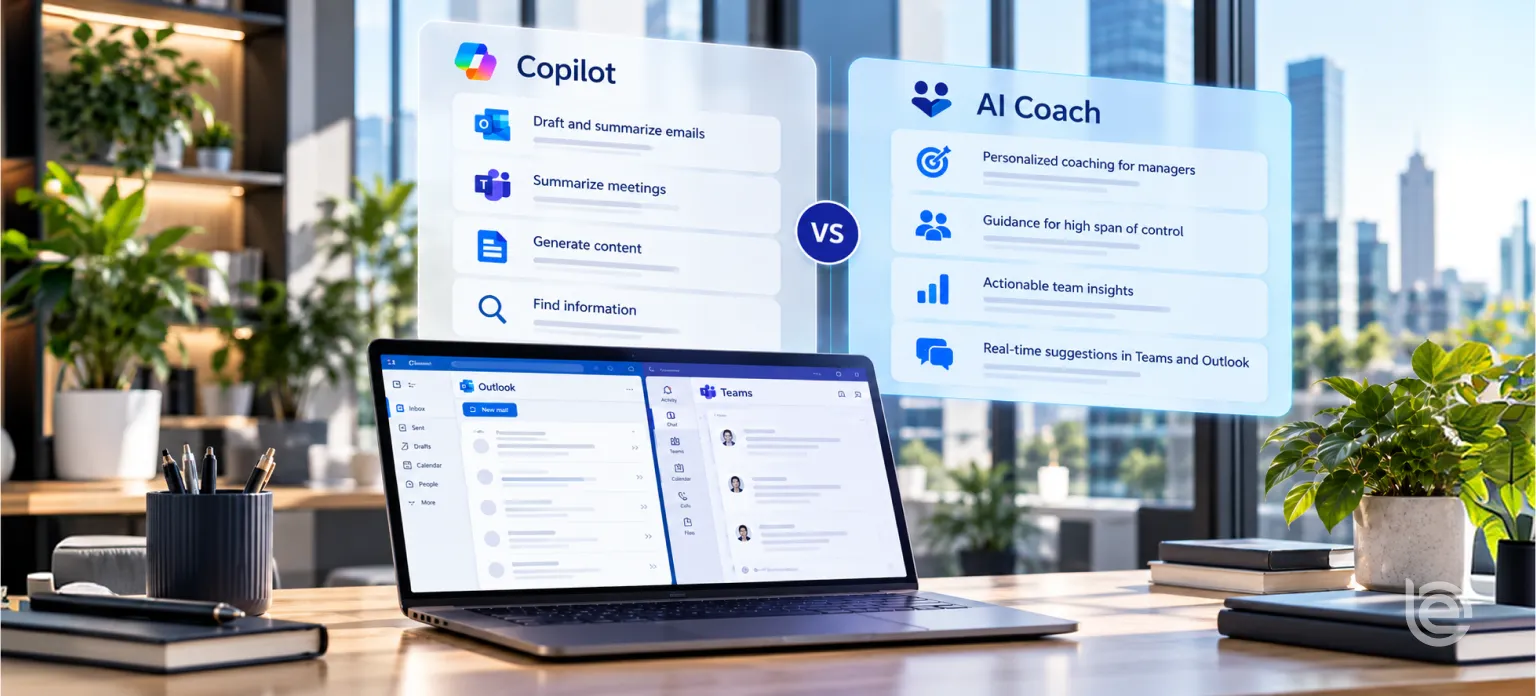
The 2026 wave is different in kind. AI is moving upstream, from writing about performance to improving the conversations that create it. That means real-time guidance for a manager walking into a hard feedback discussion. It means friction detection that flags a struggling team before the exit interviews do. It means coaching tailored to the personality and motivations of the specific person on the other side of the table, not communication tips from a listicle.
The distinction matters because manager conversation quality is the actual bottleneck in most performance systems. Gallup’s research consistently ties meaningful, frequent feedback to engagement, and managers, per Gallup’s broader work, account for the largest share of variance in team engagement. Tools that make every manager a somewhat better coach move that entire distribution. Tools that write smoother paragraphs don’t.
This is the bet behind Bullseye’s AI Coach, which delivers in-the-moment conversation guidance grounded in psychometric insight, inside the tools managers already use. The measure of success isn’t documents produced. It’s conversations that happen earlier, land better, and get followed through.
There’s a second layer arriving behind the coaching wave: agentic AI, systems that don’t just advise but act, scheduling the overdue check-in, assembling the pre-read for a talent review, chasing the development plan update that’s 3 weeks stale. Agents are genuinely useful for exactly this class of work, the administrative connective tissue that managers drop when workloads spike. The governance requirement scales with the autonomy, though. An agent that drafts and waits for approval is an assistant. An agent that acts on performance data without a human checkpoint is a decision-maker you didn’t hire. As you evaluate agentic features this year, the question to hold onto: what can this thing do without a human clicking yes, and are we comfortable with every item on that list?
Act on it: audit where AI currently touches your performance process, including the unofficial uses. Sort every use into 2 buckets: does it improve human judgment or replace it? Fund the first bucket. Govern the second hard.
Trend 2: the annual review finally loses its monopoly
The annual review has been dying in public for a decade. Harvard Business Review chronicled the shift back in 2016, when a wave of major employers dropped annual ratings in favor of continuous check-ins. What’s new in 2026 is that the laggards are moving, because the evidence has become impossible to argue with.
Gallup found that only 14% of employees strongly agree their performance reviews inspire them to improve. That’s the headline stat, but the underlying finding is worse: traditional reviews are so infrequent and so backward-looking that they function as documentation of the past rather than management of the future. A year is simply the wrong unit of time for feedback. Goals go stale in a quarter. Problems compound in weeks.
Continuous performance management replaces the single annual event with a rhythm: lightweight check-ins on a regular cadence, goals that get updated as reality changes, feedback attached to work while the work is still warm, and a year-end conversation that summarizes what both people already know instead of ambushing anyone.
The organizations that struggle with this shift usually make 1 of 2 mistakes. They keep the annual form and bolt check-ins on top, doubling the paperwork. Or they abolish structure entirely and call vibes a system. The working model keeps structure and changes frequency: structured check-ins, live goals, and multi-format reviews that draw on a running record instead of a manager’s December memory.
Act on it: if you’re still running a single annual cycle, don’t redesign everything at once. Pilot quarterly check-ins with 2 or 3 teams, keep the questions short, and measure whether year-end conversations in the pilot group get easier. They will, and that’s your internal case study.
Trend 3: performance data becomes business intelligence
For most of its history, performance data went into a filing cabinet, physical or digital, and came out only for compensation season and lawsuits. In 2026, the organizations ahead of the curve treat it as a live dataset that answers business questions: Where are our capability gaps? Which teams are at flight risk? Who’s ready for the roles we’ll need to fill in 18 months? What’s the actual return on our development spend?
This reframing changes who cares about performance management. When reviews are paperwork, HR owns them alone. When performance data feeds workforce planning, succession decisions, and budget forecasts, the CFO and COO have skin in the game. That’s how performance management stops being a compliance cost and starts being an input to strategy.
The practical requirement is integration. Ratings in one tool, goals in another, engagement in a third, and headcount in a spreadsheet can’t answer cross-cutting questions. The value shows up when performance, competency, succession, and engagement data land in 1 place, and when leadership can see it without filing a request. That’s the role of human capital BI dashboards: turning people data into the same kind of instrument panel executives already expect for revenue and operations, with KPIs aligned to SHRM and ISO standards rather than invented in-house.
For a sense of where the broader field is heading, Deloitte’s Human Capital Trends research has tracked this convergence of people data and business decision-making across several years of reports, and the direction is consistent: boards want human capital metrics with the same rigor as financial ones.
Act on it: pick 5 questions your executives actually ask about people, then check whether your current systems can answer any of them without manual assembly. That gap analysis is your dashboard requirements document.
Trend 4: manager enablement becomes the center of gravity
Here’s an uncomfortable pattern: organizations keep redesigning forms, scales, and cadences while leaving the constant untouched. The constant is the manager. Every performance process, however elegant, is delivered by a population of managers who mostly never got trained to deliver it.
The 2026 shift is treating manager capability as the primary lever rather than an afterthought. That means a few concrete things. Conversation support at the moment of need, not a workshop 8 months earlier. Nudges that keep check-in cadence alive when workloads spike. Practical scripts for the conversations managers avoid: the missed goal, the behavior issue, the promotion someone isn’t getting. And faster ramp for new managers, who inherit teams long before they’ve built the skills.
The retention stakes are direct. Gallup’s research on preventable turnover found that 42% of employees who left their jobs voluntarily say their manager or organization could have done something to keep them, and the something usually involves a conversation that never happened. Managers don’t skip those conversations out of malice. They skip them because the conversations are hard and nobody’s helping.
Act on it: stop measuring manager enablement by training completion. Measure it by conversation outcomes: check-in frequency, feedback specificity, and how often development plans get updated after they’re written. Then give managers in-the-moment support, whether through AI-driven coaching or structured guides, aimed at the exact conversations they currently avoid.
Trend 5: competencies and skills displace job titles
Job titles describe boxes. Work increasingly refuses to stay in them. Between reorganizations, AI reshaping task mixes, and internal mobility becoming a retention strategy, organizations need to know what people can do, not just what their title says. That’s pushing skills and competencies from an L&D side project to the core data model of performance management.
The mechanics look like this: a competency framework defines target levels for each role, assessments track where individuals actually are, and the gap between the 2 drives development plans, staffing decisions, and succession pipelines. Done well, this also answers the question employees care about most: what do I need to demonstrate to get to the next role? Career paths built on visible competency requirements feel achievable. Career paths built on unwritten rules feel like politics.
The learning connection is where this pays off. Harvard Business Review’s work on reskilling in the AI era makes the case that reskilling now has to function as a core business process rather than an episodic program, and a competency model is the data layer that makes that possible. You can’t close gaps you haven’t mapped.
Act on it: don’t boil the ocean with a 400-competency library. Start with your 10 most critical roles, define 5 to 7 competencies each with observable behavior anchors, and connect assessment results to training plans so a gap always triggers an action.
Trend 6: goal transparency goes from radical to expected
Cascading secret goals down an org chart made sense when strategy changed annually and information moved through memos. Neither is true anymore. In 2026, the norm among high-performing organizations is visible goals: anyone can see what any team is driving toward and how it connects upward.
The framework carrying this trend is still OKRs, objectives and key results, and the reason is alignment mechanics. When objectives are public and key results are measurable, 3 useful things happen. Duplicate work surfaces early, because 2 teams chasing the same outcome can see each other. Dependencies get negotiated before they become blockers. And individual contributors can trace a line from their week to the company’s strategy, which is a quiet but real engagement driver.
The failure mode to avoid is using goal transparency as surveillance. If visible goals become a stick, people sandbag them, and the whole system converges on safely achievable mediocrity. Goals set collaboratively, reviewed in regular check-ins, and treated as navigation rather than judgment keep their honesty.
One measurement note, because it decides whether OKRs survive contact with your compensation cycle: keep key result scores out of the ratings formula. The moment a key result score directly determines pay, every objective in the company gets negotiated down to a sure thing, and you’ve built an elaborate system for documenting sandbagged targets. Goal data should inform performance conversations as context, evidence of ambition, execution, and course-correction, while the evaluative judgment stays separate. Organizations that hold that line keep stretch in their goals. Organizations that don’t get beautiful dashboards of green checkmarks and no idea where their real risks are.
Act on it: if you’re introducing OKRs, run 2 quarters at the team level before asking individuals to write them. Team-level OKRs deliver most of the alignment value with a fraction of the change management pain.
Trend 7: responsible AI governance becomes a performance management requirement
Trend 1 puts AI deeper into performance workflows. Trend 7 is the bill for it: 2026 is the year AI governance stops being optional for HR. Regulators are moving, employees are asking pointed questions, and the gap between “we use AI” and “we can explain how we use AI” is turning into legal and reputational exposure.
For performance management specifically, governance means answering 4 questions in writing. Which AI uses are encouraged, which require human authorship, and which are prohibited? What employee data can and can’t enter AI tools? Who is accountable for an AI-influenced decision? And how would you detect it if an AI-assisted process produced biased patterns over time?
You don’t need to invent the structure. The NIST AI Risk Management Framework gives you the govern-map-measure-manage skeleton, and translating it into a 1-page policy for managers is a quarter’s work, not a transformation program. The organizations that do this early get a side benefit: employees trust AI-assisted processes far more when the rules are public.
Act on it: write the 1-pager now, before an incident writes it for you. Cover permitted uses, prohibited uses, data handling, and disclosure. Then make ratings, promotions, and terminations explicitly human-only decisions.
Trend 8: performance, succession, and pay stop being separate conversations
The traditional model runs 3 disconnected cycles: performance reviews in 1 system, succession planning in a boardroom slide deck, and compensation in a spreadsheet guarded by 2 people. Employees experience the disconnection directly: a strong review that connects to nothing, a promotion process nobody can explain, a raise that seems unrelated to either.
The 2026 model connects them. Performance and competency data feed succession pipelines, so readiness is an evidence-based judgment rather than a hallway reputation. The same data informs compensation planning, so pay decisions trace to documented performance. And employees can see the through-line, which is what makes the whole system feel fair rather than arbitrary.
The retention math here is strong. Gallup’s data on job-hopping shows development and growth opportunity are dominant drivers for the generations now making up most of the workforce, and Pew’s research on how Americans view their jobs finds satisfaction with promotion opportunities is among the lowest-rated aspects of work in the US. People don’t leave companies that show them a credible path. They leave companies that make the path a secret.
Act on it: pick 1 connection point this year. The highest-value starter is linking review outcomes to succession readiness for your critical roles, because it forces performance data to be good enough to act on.
The KPI starter set: 12 numbers worth tracking
Trend 3 says performance data should work like business intelligence, so here’s the concrete version: 12 KPIs that form a defensible starter dashboard, grouped by what they tell you. Definitions matter more than dashboards, so each comes with the one that survives arguments.
Process health, the leading indicators: 1. Check-in completion rate: percentage of scheduled check-ins documented within their window. Below 70% means your continuous model is annual reviews wearing a costume. 2. Feedback recency: percentage of employees with any documented feedback in the last 30 days. This is the single best predictor of whether year-end conversations will contain surprises. 3. Goal freshness: percentage of active goals updated in the current quarter. Stale goals mean the system has detached from real work. 4. Review specificity score: sampled reviews rated for concrete evidence per assessment. The quality metric that catches both lazy humans and lazy AI.
People outcomes, the middle layer: 5. Regrettable turnover rate: voluntary exits of employees rated in your top 2 performance bands, tracked separately from overall turnover, because losing your 10th percentile and your 90th percentile are opposite events that a blended number hides. 6. Internal fill rate: percentage of posted roles filled internally, with critical roles broken out. 7. Development plan momentum: percentage of active development plans with recorded progress this quarter. 8. Feedback trust score: the survey item “my last performance conversation reflected genuine understanding of my work”, trended over time.
Business connection, the layer executives actually read: 9. Pipeline coverage: critical roles with at least 1 ready-or-near-ready successor, straight from your succession data. 10. Time to productivity: ramp time for internal moves versus external hires into comparable roles. This number usually makes the internal mobility business case by itself. 11. Manager span health: distribution of check-in and feedback metrics by manager, flagging the outliers at both ends, because your worst quartile of managers is where most preventable attrition lives. 12. Performance-pay alignment: correlation between documented performance outcomes and compensation decisions. Not because the correlation should be perfect, but because an inexplicable pattern here is legal and cultural risk announcing itself early.
Two rules for using the set. First, baseline before you target: half these numbers will be uncomfortable on first measurement, and that’s information, not failure. Second, never report a number without a named owner and a decision it informs. A KPI nobody acts on trains the organization to ignore the dashboard, which is worse than not building one. Standards-aligned definitions help here too; building on SHRM and ISO-recommended human capital metrics, the approach behind Bullseye’s BI dashboards, means your numbers survive benchmark comparisons and auditor questions alike.
The stack question: build, buy, or consolidate
Every trend above eventually becomes a systems decision, so let’s have the unglamorous conversation directly. Most HR teams reading this are running somewhere between 4 and 9 tools that touch performance: an HRIS with a neglected performance module, a survey tool, a goals product someone bought in 2022, spreadsheets doing succession, and now a shadow layer of AI tools nobody procured. The 2026 question isn’t which new thing to add. It’s how to get from sprawl to spine.
When point solutions make sense: you have 1 acute, isolated problem and a mature stack everywhere else. A best-of-breed survey tool for an organization whose performance and succession systems already talk to each other is a reasonable buy.
When they don’t: the moment your questions cross domains, and Trends 3 and 8 are entirely cross-domain questions. “Which high performers lack successors and show engagement decline” is unanswerable when performance, succession, and engagement live in 3 products with 3 data models. You can theoretically integrate your way out, but HR integration projects have a way of consuming the budget that was supposed to fund the actual improvement, and every vendor’s roadmap changes eventually break something. Sprawl also multiplies your AI governance surface: every tool with its own AI features is another data processing agreement, another bias audit question, another place policy has to reach.
The consolidation logic: platforms where performance, goals, competencies, succession, engagement, and analytics share 1 data model answer the cross-domain questions natively, carry 1 governance surface, and, the underrated part, present managers with 1 place to work instead of 5 logins they’ll ignore. The trade-off is real: a suite’s individual modules may each be 80% of the best point solution. The question is whether 5 disconnected 100% tools beat 1 connected 80% platform, and for the trends in this article, connection wins, because the value lives in the joins.
The build temptation: internal teams sometimes propose building the connective layer in-house, usually on top of the data warehouse. It works for reporting. It reliably fails for workflow, because dashboards don’t remind managers, route approvals, or coach conversations, and the maintenance burden lands on an analytics team that didn’t sign up to run an HR product. Build your analysis layer if you have the talent; buy your workflow layer.
A modular platform structure, subscribing to what you need now and adding as maturity grows, splits the difference sensibly, which is the model Bullseye’s platform runs on. Whatever you choose, choose against your 3-year question list, not your current pain point, because the current pain point is just the trend you noticed first.
How the trends land outside corporate HQ
Most trend coverage is written for tech companies and reads that way. The 8 trends above apply across industries, but they land differently, and if you run HR in healthcare, government, education, or industrial settings, the sequencing changes.
Healthcare feels Trend 5 first and hardest. Competency management isn’t a modernization project in a hospital; it’s adjacent to credentialing, accreditation, and patient safety, which means the data discipline usually already exists and the gap is connecting it to performance and development rather than building it from scratch. The manager enablement trend also carries extra weight here: clinical leaders are promoted for clinical excellence and handed teams with almost no management preparation, in an environment where burnout makes every avoided conversation expensive. Continuous check-in models need adaptation for shift-based work, shorter and asynchronous, but the underlying rhythm matters more in 24-hour operations, not less.
Government and public sector organizations should start with Trends 3 and 7. The dashboard trend aligns with an accountability culture that already reports metrics upward, and public sector AI governance expectations are arriving faster and stricter than private sector ones, so writing the AI policy early is cheap insurance. The succession connection in Trend 8 is often the sleeper priority: public agencies carry some of the deepest retirement-driven continuity risk of any sector, with pension structures that make departure dates predictable years ahead. That predictability is an advantage no private employer gets, and most agencies waste it.
Industrial and field-based organizations should resist the assumption that continuous performance management is an office concept. A distributed workforce with low screen time needs mobile-first check-ins and supervisor-mediated cadences, but the payoff is larger precisely because informal feedback channels are weaker when the team doesn’t share a hallway. Skills-based models, Trend 5, also map naturally onto environments that already think in certifications and qualifications; the work is unifying safety, technical, and leadership competencies into 1 framework instead of 3 parallel bureaucracies.
The general rule: don’t adopt the trend list, adopt the 2 trends your operating model is already leaning toward, and let the adjacent ones follow the data trail.
Making the business case: what each move costs and returns
Trends don’t fund themselves, so here’s how the money conversation goes for each major move, in the language that survives a CFO meeting.
Continuous performance management is the cheapest structural change on the list, because it’s mostly a redesign of time, not a purchase. The cost is change management and manager hours; the return case is built on turnover. Take Gallup’s finding that 42% of voluntary turnover is preventable, multiply your annual voluntary departures by your loaded cost per departure, and even a conservative single-digit improvement in preventable exits covers the program several times over. The pilot structure from the 90-day plan below exists partly to generate your own numbers for this math.
Manager enablement tooling prices per manager, which makes the ROI framing natural: cost per manager per year against the value of that manager’s team performing even marginally better and turning over even slightly less. Given the outsized share of engagement variance managers explain, this is the line item with the most forgiving break-even on the list. The evaluation risk isn’t overpaying; it’s buying content libraries that managers won’t open instead of in-workflow support they will. Usage rate is the metric that decides whether you got the ROI, so contract for visibility into it.
Dashboards and analytics should be costed as decision infrastructure, not HR software. The business case is the cost of the decisions currently made blind: the reorganization planned without capability data, the retention crisis detected 2 quarters late, the succession gap discovered by resignation. Pick 1 recent expensive surprise, price it honestly, and ask what fraction of it a live view would have saved. That number is usually the whole budget.
Competency and succession infrastructure has the longest payback and the largest terminal value, which is exactly why it needs the phased approach from Trend 5: 10 critical roles first, not 400. Early value comes from risk visibility, which costs almost nothing to surface and tends to alarm executives into funding the rest. The full return arrives when internal fill rates for critical roles climb, and every internal fill you can attribute to the pipeline is a recruiting fee, a ramp period, and a failure risk you didn’t pay for.
Sequence the spending the same way you sequence the trends: fund the fast-payback moves first, and let their measured results underwrite the infrastructure plays.
3 hyped ideas that will flop
A trends list that endorses everything is marketing. Here’s what we’d bet against in 2026.
Sentiment surveillance. Tools that mine employees’ messages and meeting behavior to infer engagement or performance will keep getting funded and keep failing. The signal is weak, the privacy cost is enormous, and the first time an employee learns their Slack tone affected their rating, you’ve traded a metric for your culture. Measure outcomes and ask people directly through a proper engagement survey. It’s less exciting and it works.
Fully automated ratings. Vendors will pitch algorithmic performance scores as bias-free objectivity. They’re neither. Automated ratings launder historical bias through math, destroy the manager accountability that makes ratings mean anything, and collapse the moment an employee challenges one in a legal setting. Analytics should inform calibration, not replace it.
Engagement theater. Pulse surveys every week, dashboards nobody acts on, and recognition programs that substitute confetti for career growth. Measurement without action doesn’t just waste money; it teaches employees that feedback goes nowhere, which is worse than not asking. Every survey should have a named owner for the action plan before it launches.
Your 90-day action plan
Trends become results through sequencing. Here’s a realistic first quarter.
Days 1 to 30: diagnose. Run the AI audit from Trend 1. Pull the 5 executive questions from Trend 3. Survey managers on which performance conversations they avoid and why. Baseline your current numbers: check-in frequency, review specificity, percentage of critical roles with a ready successor.
Days 31 to 60: decide and draft. Write the 1-page AI governance policy. Choose your continuous-performance pilot teams. Define competencies for your 10 most critical roles. Pick the 1 systems connection you’ll build this year, performance to succession being the default recommendation.
Days 61 to 90: pilot and instrument. Launch quarterly check-ins with pilot teams. Stand up a first-version dashboard answering 3 of the 5 executive questions. Give pilot managers conversation support and measure usage. Set the review date for day 120, with the explicit question: what earned expansion, and what didn’t?
Ninety days won’t finish anything. It will make you the organization acting on 2026 instead of reading about it.
Frequently asked questions
Which trend should a resource-constrained HR team pick first? Manager enablement, Trend 4. It improves outcomes under any process design, it doesn’t require ripping out systems, and every other trend depends on managers executing well. Better managers make a mediocre process work. The reverse isn’t true.
Are annual reviews completely dead? The annual conversation isn’t dead; the annual surprise is. A year-end summary discussion still has value for reflection, compensation input, and formal documentation. What’s ending is the model where that conversation carries the entire feedback load for the year.
How do we get executive buy-in for this investment? Lead with Trend 3. Executives fund instruments, not initiatives. Show them 5 business questions they currently can’t answer about their own workforce, then show them the dashboard that answers them. Performance process improvements ride along as the data supply chain for that dashboard.
Do these trends apply outside of tech and corporate settings? Disproportionately, yes. Healthcare, education, government, and industrial organizations often have the largest gaps between current practice and these trends, which means the largest returns. Competency management in particular tends to land faster in credential-driven industries because the culture already thinks in demonstrable skills.
How long before any of this shows up in business results? Set 3 clocks. Behavior metrics move in a quarter: check-in completion, feedback frequency, tool usage. Perception metrics move in 2 to 3 quarters: engagement survey items about feedback quality and career clarity. Business metrics, retention, internal fill rate, ramp time, need 12 to 18 months to show a trend you can defend. Report all 3 layers from the start so leadership watches the leading indicators move while the lagging ones catch up. Programs get cancelled in month 8 because someone promised turnover improvements by month 6.
What should we stop doing to make room for this? More than you’d think, and saying so out loud is half the change management. Strong candidates for the bin: review forms longer than 1 page, ratings on more than 1 scale, mid-year paperwork that duplicates the year-end, competency libraries with 200 entries nobody references, and any survey whose last 3 runs produced no visible action. Every hour of process you retire buys credibility for the process you’re introducing. Managers believe “this will be lighter” only after they’ve watched you delete something.
How do we bring along managers who’ve seen 3 of these redesigns fail before? Don’t argue with their skepticism; it’s earned. Three things work. Pilot with volunteers first, because skeptics convert on peer evidence, not HR enthusiasm. Cut visible process before adding any, per the question above. And put the pilot’s before-and-after numbers in front of them, including what didn’t improve, because an honest mixed result is more persuasive to a veteran skeptic than a perfect one. The managers who push back hardest usually become the best adopters once convinced, since their standard was always “does this actually help me” rather than “is this new”.
How should we evaluate vendors against these trends? Ask every vendor 3 questions. Where does your AI improve human judgment versus replace it, and show me the line in the product. Which of my executive questions can your analytics answer on day 1 versus after a services engagement. And what does adoption look like at your median customer, not your best one, because the gap between demo and median usage is where these purchases die. A vendor who answers all 3 crisply is rare and worth shortlisting for that alone.
How do we keep continuous feedback from becoming continuous administration? Ruthlessly cap the artifact. A check-in is 3 questions and 15 minutes, not a mini review; if managers are writing paragraphs monthly, you’ve multiplied the annual review by 12 instead of replacing it. The test: an individual contributor should spend under 30 minutes a month on performance process mechanics, and a manager under 30 minutes per direct report. Anything above that, cut fields until you’re under it. The conversations are the product; the records exist to serve them.
What’s the biggest implementation mistake you see? Launching everything simultaneously. A continuous-performance rollout, new competency model, new OKR framework, and new dashboard in the same quarter guarantees shallow adoption of all 4. Sequence them, prove each with a pilot, and let internal results do the persuading.
The bottom line
The 8 trends of 2026 share a single spine: performance management is becoming continuous, data-driven, manager-centered, and honest about AI. The organizations that win won’t be the ones that adopt the most tools. They’ll be the ones that pick the right 2 or 3 moves, sequence them, and measure relentlessly.
If you want to see how continuous performance, AI coaching, competency data, and executive dashboards work as 1 connected system, book a demo with the Bullseye team. We’ll map the trends to your current state and show you the shortest path to acting on them.